(photos © Kate Poland)
(photo © Lisa Barr)
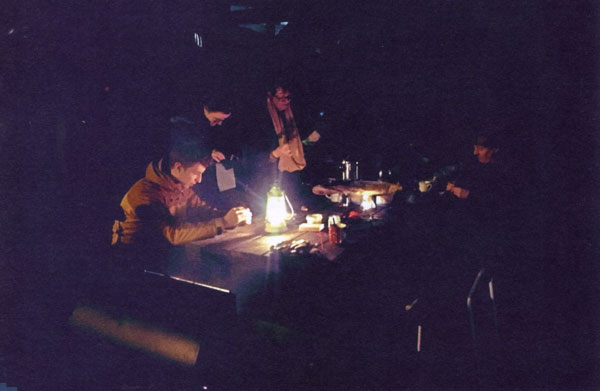
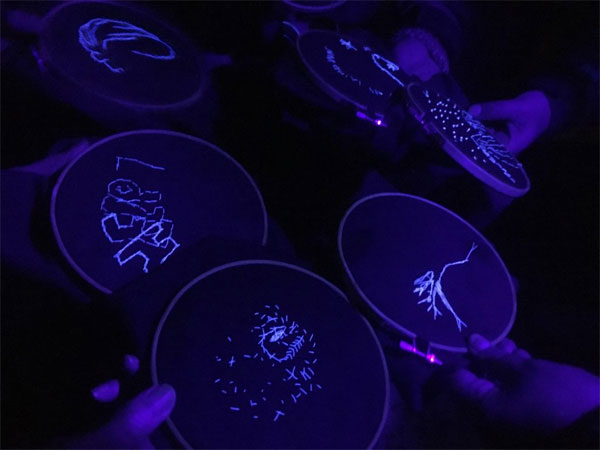
In a community garden in Hackney, Cordwainers Grow has recently and sporadically organised what we call Embroidery in the Dark events. We run a weekly indoor embroidery class, but some of us (well, me, really!) lack much skill or application, so I thought that, if we did our sewing in the dark and outdoors, it would release us from the tyranny of making something look good. It's ideal for the incompetent and lazy!
To be in an urban garden at night brings a mixture of wildness - it's actually quite dark - and community, and reveals the life that goes on in these spaces that isn't just about gardening.
Our first Embroidery in the Dark session was in Extinction Rebellion's Garden of Earthly Delights. After a hot summer, we picked a night when it bucketed with rain. We sat, cold and wet but determinedly sewing with fluorescent thread. The final works were less important than just being outside, in the dark, with other people. We felt great afterwards.
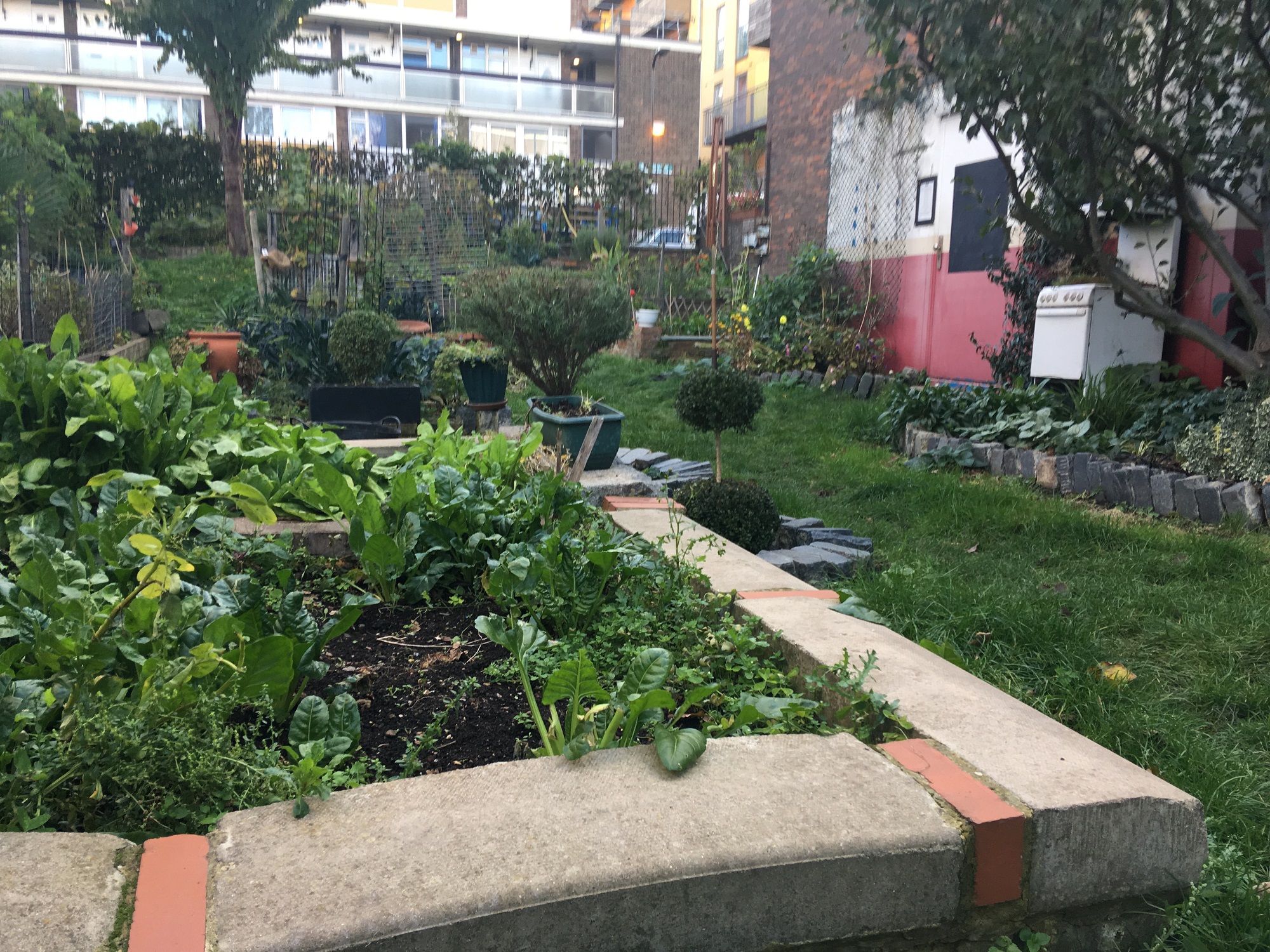
Our second night-time embroidery venture was in the Growing Kitchen on the Wenlock Barn Estate near Old Street, in the autumn. We had a small fire and candles (as well as cake of course) and as we sat there blindly sewing, people popped into the garden - to enquire about a homeless person who'd been seen there, to feed a stray cat, to have a smoke or to just come and sit quietly.
It reminded me that community gardens are not just green spaces for gardening: they provide safe areas for local people when there is a shrinking amount of public land.
Most gardens are small but provide space, activity, social interaction and support - not to mention food - for a large number of people. Their benefits go far beyond a bit of grow-your-own. In the last year my organisation, Cordwainers Grow, has set up a network of community gardens, orchards and wild spaces called the Union of Hackney Gardens. We hope we can protect, promote and support these places by joining together. We have forty-two members. With an increasing population and shrinking land available, community spaces are more and more under threat, but at the same time more important as new developments generally do not provide much private green space - yet so many developments damage or destroy the communal green spaces that are already there.
Cordwainers Grow evolved from Cordwainers Community Garden, which was closed quite heavy-handedly last year by the landowners so that it can be developed. It was their land, not ours, so that was, of course, their right, but we wanted to make sure that similar successful garden ventures would have better protection, and that means that these small spaces need to be seen, their value recognised and their opinions heard.
One of our members is the De Beauvoir Estate community garden. I visited it recently and met several gardeners and estate residents who are worried about its future. It provides growing spaces for 25 households and none of the gardeners knew each other before they met at the garden. It is also a place for other residents to enjoy in peace: somewhere to, as they say, relax and de-stress. One gardener told me she suffers from OCD and often struggles to get out of her flat as she gets trapped by her rituals, but tending the garden forces her outdoors, which breaks the cycle and lifts her mood. Another resident lost a baby and said that the gardeners and the garden itself help her get through the days. Like the Growing Kitchen, their garden serves many needs - not just grow-your-own.
A new development is going up and will doubtless have an impact on the garden. A block for mostly social housing is being built right next to the garden and the residents fear it will destroy their thriving growing space; the gardeners say the garden will not be usable once the construction starts because the building will overshadow their growing area. Council members say that the space they will be building on is 'underused' and that homes are 'much-needed'. This is true, but there is a terrible tension between the need to build homes and the need for a healthy environment to keep residents well - and out of GP surgeries. This is not acknowledged and residents feel ignored.
Another proposed development nearby affects one of our wildlife spaces. it will create both shadow and light pollution which will damage the ecology that the team there have been successfully encouraging.
These community green spaces, about a mile apart, are small and serve a very local constituency as most gardens do. One of the reasons for forming the Hackney Union was to make these sorts of places more visible and their benefits more widely known - and to connect them to each other. One benefit of having a union is to have a voice. As a group, we can be heard - by the council in particular. Just recently we have been asked to comment on its new parks strategy We can also share knowledge, skills and support, not just about gardening but, increasingly importantly in these times, about planning matters. At the very least we can turn up as a group to planning meetings to show the level of concern over decisions being made about our environment. Ideally we will be consulted before plans go to committee - to collaborate with developers, rather than arriving at the end of the process feeling trodden on and therefore hostile.One of the ways in which we are working to make our green spaces more visible is by mapping walks which show where community gardens are and how they can be linked by a gentle stroll. Last summer we received a small amount of funding to organise five walks to and between community growing spaces, After practising and photographing the walks using an app called Ramblr, we worked out routes that took in three or four gardens, either beginning or ending up with tea and cake. After much agonised proofing and subbing we have just produced five maps available as PDFs, which take you around the borough and list more gardens in the area. We now have so many gardens in our network that we are looking at producing a second edition this year.
By using our green spaces - for our mental and physical health, for food growing, to provide nature habitats and to clean our air - and by connecting them to each other - we can, I hope, protect them. If you want to help and do something for your local community space, just go and sit in it and do nothing. If you have the urge though, you can take an embroidery hoop and wait for nightfall.