

Introduction
Putney is in west Wandsworth, with the boroughs of Richmond to the west, Merton to the south and Lambeth to the east.
In the 18th century, when the burial ground was established, Putney was and still is an affluent place, it had many rich residents. One of the first of the wealthy and influential people to settle in Putney was John Lacy, a member of The Clothmakers Company (a Livery Company) in the City. Lacy was close to Queen Elizabeth I, and she visited him at his home in Putney on at least a dozen occasions. John Lacy has a road named after him, Lacy Road adjoins Putney High Street.
Taking the Lower Richmond Road from Putney Bridge towards Barnes you come to the adjoining common lands of Barnes and Putney Lower Commons. This is part of the extensive green corridor stretching from WWT Wetlands in the north through Barnes and Roehampton to Richmond Park and Wimbledon Common in the south.
We were drawn to this small patch of common lands because hidden away were two small Victorian burial grounds lying close together, and largely abandoned. The Richmond/Wandsworth boundary passes between them, and they are managed separately. Surrounded by woodland, tangled shrubs and open spaces, crisscrossed by paths these burial grounds are little known.
Barnes Cemetery is a wild area, the unkempt part of the Commons but enthralling and atmospheric. Gravestones are at angles or damaged, trees and shrubs invade their spaces, paths wind haphazardly round the old graveyard.
Putney Lower Common Burial Ground is the tidier one with paths gently managed, but that too has a wild area. This graveyard is lighter and sunnier. Walking round both graveyards exploring is a true pleasure.
Putney Old Burial Ground
Putney Old Burial Ground can be found on the Upper Richmond Road, Putney. It’s quite difficult to spot, hidden behind a bus stop with only one entrance into the ground. There are local people today in Putney who do not know of its existence!

As can be seen, it’s difficult to spot the entrance to POBG from this photo. There is, however, a large ugly granite block, just visible in the picture, stating Putney Old Burial Ground.
History of the burial ground.
The land for the cemetery was given, for a fee, to the people of Putney by The Reverend Roger Mortlock Pettiward D.D. in 1763, he was described as “immensely rich” (1). The Reverend Pettiward was part of a family that were large landowners. The Pettiward’s had owned land in Putney since the reign of Charles 2nd in the 17th century. They also part owned the ferry that crossed over the Thames from Putney to Fulham. When the first bridge was built in 1729 across the Thames joining the parishes of Putney and Fulham the family were very well compensated.

Above, The Reverend Pettiward’s grave.
There are some very sad statistics for the graveyard, of the 450 people buried there, more than 60 are children. The very first burial was at the cemetery was on the 16th of December, 1763 documented as “Ann Colman infant, ye first corps in ye new burying ground”. (2).
The last burial was in 1854, and up until the 1960s when the council took over the running of the cemetery, the site was badly neglected. It was changed into a park, and many graves were removed and placed in the corner of the cemetery.
Notable Burials
Charles Fox Canning was Aide-de-camp to the Duke of Wellington, he died at The Battle of Waterloo on the 18th of June 1815 aged 33. He is buried in the table vault of the Canning family.

Above, the tomb of the Canning family.
Rev. St. Aubyn
Rev. Richard John St. Aubyn’s grave puts his year of birth as 1807 and died in 1849, at the young age of 42. He was the 13th of 15 children whose father was Sir John, 5th and final Baronet of St. Aubyn who died in 1839 (3). The Reverend’s mother was Martha Nicholls, and I cannot find any details for her. The father of Rev. Aubyn has been recorded as saying that he can’t remember the mothers of the first two of his children except that they were Italian! (3). The Reverend in Putney burial ground is directly related to the St. Aubyn family in Cornwall, who own St. Michael’s Mount. The burial plot of the reverend has been sadly neglected by the groundsmen, as can be seen in the photo below.

The above photo was taken in November 2024. As a result of this neglect, I took it upon myself to cut back some of the growth. As can be seen from the photo I took in December 2024, the grave can now be viewed. I have written to the company that is supposed to look after the graves asking them to continue to keep back the overgrowth.
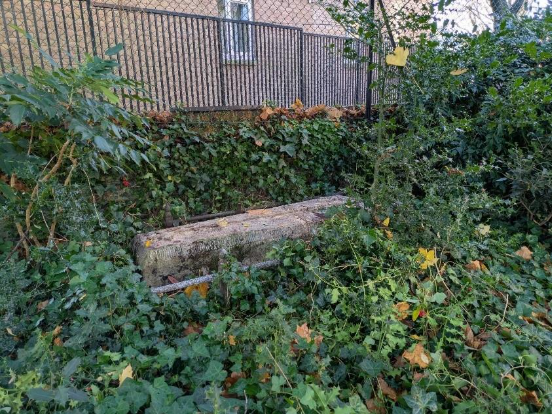
Above, Rev. St Aubyn’s burial plot.
James Scarth. The grave with a missing body!
James Scarth was a property developer and the owner of large areas of land in Putney. Due to a challenge on the estate of James Scarth a decision was made to exhume the body, however, for reasons unknown, his coffin was not in the burial ground, and remains missing to this day! His wife and daughter remains are still in the burial plot. (3).

Above, the headstone of James Scarth, it’s difficult to read but it states he was born in 1769 and died in 1828.
Biodiversity
A “site of local importance for nature conservation” and one of the UK’s most rare of wildflowers grows in Putney Old Burial Ground, namely the Jersey Cudweed, a protected wildflower under the Wildlife and Countryside Act of 1981 (10).

However, you’ll find it hard to spot because it doesn’t appear to be growing there anymore. I can’t help but wonder if scrub clearances inadvertently dug all the specimens up, who knows?
The burial ground is home to six very large London Plane trees and another six equally large oak trees, likely planted when the burial ground closed in 1854. There are a couple of birch trees and a fir tree. There are lots of various bushes, including holly, mosses and ferns around the burial ground. Stag beetles have also apparently been spotted there. (10).
Two views of the burial ground.

The view looking south, spot the headstones!
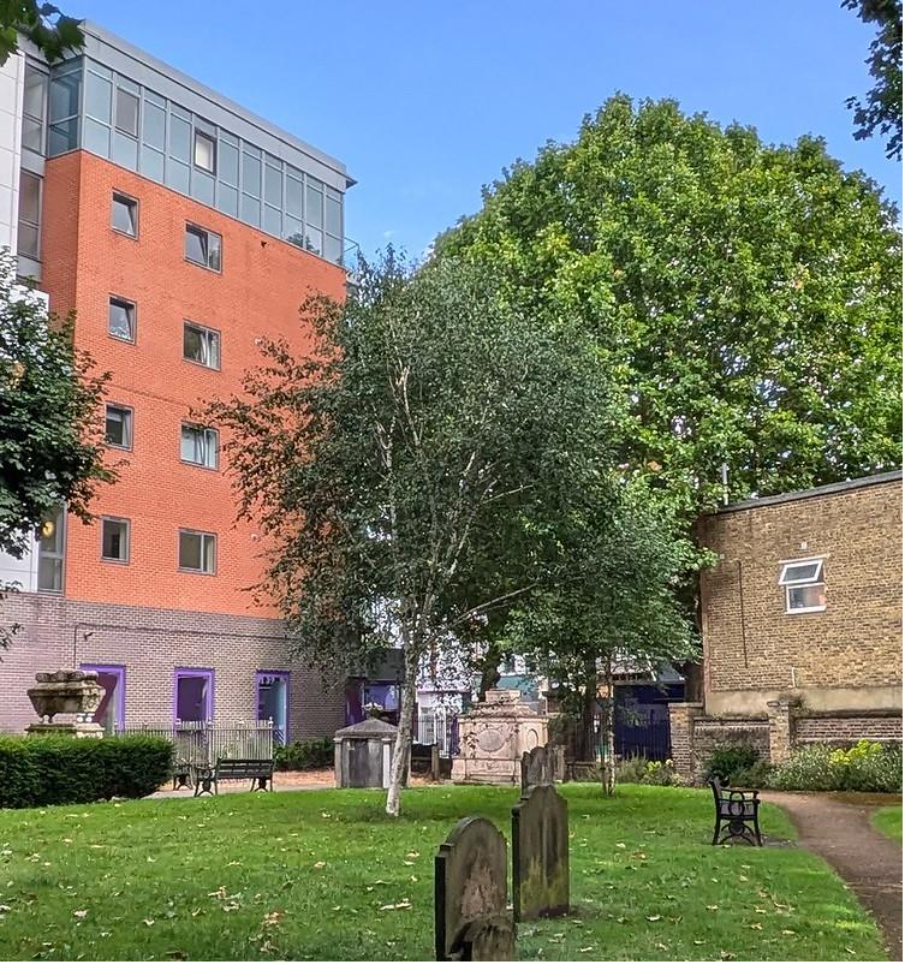
The view looking north.
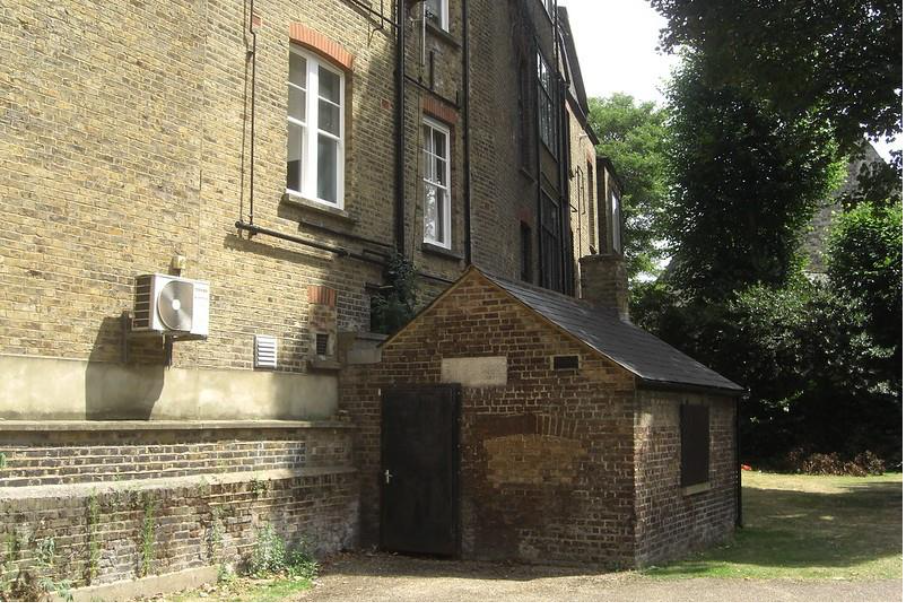
The old mortuary, which has a stone dated 1763, still stands in the burial ground.
Putney Old Burial Ground is without a doubt a fascinating little cemetery. It is full of the rich and influential people from Putney’s past 260 years, several Whig MPs, and several vicars quite a few very rich land-owning individuals are buried here. A few servants have managed to sneak in too, it seems because they were live in staff and much cherished by their employees, and so when they died, they were often buried in graves alongside their previous ‘masters’.
When the local council decided to change the use of the burial ground to a park in 1963 they moved over a hundred of the headstones, many of which were up to two hundred years old, placing them in the corner of the cemetery. Two grave markers were placed in the entrance of a café.
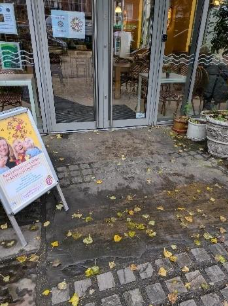
Above, the entrance to the café with two grave marker slabs. The café is at the entrance to St. Mary’s church on Putney High Street.
Putney Lower Common Cemetery history
By the mid-19th century, Putney Old Burial Ground) was overcrowded, and by 1854 there clearly was a need to build another cemetery for the parish, a common problem for parishes in London as the population was growing so quickly.
So, on the 26th August 1854 the Putney Burial Board received a request for a new cemetery from 15 local builders and business men. The request was accepted and only 3 weeks later Earl Spencer who owned much of the local commons round Putney and Wimbledon agreed to sell 3 acres of his land for £360.
By February of the following year William and Robert Avis, two of the original proposers of the new cemetery won the tender to build at a cost of £2314. The cemetery was consecrated in the August of that year. Victorian builders certainly moved fast!

This cemetery became the main Putney graveyard until the end of the century when in 1891 it was officially closed when Putney Vale was opened. However, burials have taken place there since then to as recently as 1975. Nowadays this quiet corner of Putney is monitored by The Friends of Putney Lower Common Cemetery who raised money for restoration work on the chapel building inside the cemetery. This has now been converted into a private dwelling in 2017 and the entrance lodge now houses a popular café.
Barnes Cemetery history
The living of St Mary’s Barnes was in the gift of the Dean and Chapter of St Paul’s, who also owned Barnes Common so when the need for a new parish cemetery was necessary two and a half acres of the Common was assigned to the parish for £10. Like Putney the graveyard opened in 1855. By the mid-20th century, it was almost full and the site was closed in 1954.

Richmond Council took over management of the site from Barnes in 1965 and planned to convert it to a garden of rest, but this was abandoned and the cemetery became increasingly overgrown and vandalised. In 1980 it became incorporated into Barnes Common as part of the Local Nature Reserve. Today it is wild and wooded and, despite being alongside the playing fields and courts of Rocks Lane, remains hidden with a gothic atmosphere.
Through the seasons
Spring
It is a sunny morning in April and we walk round the two old burial grounds. A nuthatch loudly calls, blackcaps, chiffchaffs, great tits, blue tits and robins are all proclaiming their territories and their suitability for the females. The newly opened leaves on the trees are a vivid green to be savoured. New grass pushes up through the damp soil. Alkanet and garlic mustard line the paths in blues and creams. On the trees the horse chestnut candles and hawthorn blossom lighten up the wood. The tree canopy above us has not fully opened out yet and the sunlight can still make its way through.
Summer
Over two months have passed since we last wandered searching the tumbled and eroded gravestones. It is warm and we take more time to look at the gravestones. Victorian life is laid out in the words there – life is often brutal – how many young children are laid here? how many young wives? And now in late June, in both cemeteries, the grasses, nettles and brambles have grown unchecked, some nettles reaching over our heads. The dappled sun through the trees is warm. Butterflies – meadow brown, speckled wood and small copper- flutter round the oxeye daisies, hawkweed and hedge parsley. From the tree and shrubs blackcap, chiffchaff and robins are still heard, but not so vigorously now.
Autumn
Already the equinox is here and the sun is lower and weaker, but the heat remains. The sycamore leaves have already turned brown and crinkled. A false acacia is a startling yellow, getting ready for the later autumn colours. Inside Putney burial ground the Yews have berries on them, but the blackberries on the brambles are shrivelling up and, in a sheltered sunny spot, blue scabious attracts bees . On the open land of Barnes Common yarrows line the paths and a few butterflies, large white and meadow brown, still flutter in the sun. There are several small tit families up in the canopy, the occasional robin is heard singing their crisp, rather melancholic autumn song, and a pair of great spotted woodpeckers call out disturbed by something unseen. A magpie rustles around in the low branches, whilst a squirrel nearby campers among the dead leaves.
Winter
It is the last day of the year, and a storm is forecast for later, but for now all is calm, but grey, damp and cold. In both graveyards several fallen branches lie over old gravestones, testament to the storms of recent weeks. The paths are clear though and fallen autumn leaves lie thick along the edges. On a few decaying trees ‘turkey tail’ and ‘velvet shank’ fungi cluster along the bark. Some bulbs are already pushing through in Putney Cemetery and out on Barnes Common the gorse bushes have yellow flowers -signs of a mild if stormy winter so far. Crows, parakeets and magpies are the dominant bird sounds, whilst robins call quietly from the bushes. A great spotted woodpecker drums in the distance while another calls high above us looking for food. But the biggest surprise was the sudden sight of a tawny owl flying silently through the branches and quickly disappearing before we could say no more than “wow”!
Two notable residents
Benjamin Waterhouse Hawkins (1807-1894) lies in Putney Lower Common Cemetery. He was the sculptor who made the dinosaurs in Crystal Palace – still there for us all to see.

He unveiled his dinosaurs in 1854, the world’s first full reconstruction of dinosaurs. They look to us a little incorrect these days, but at the time were based as accurately as possible on what scientists knew. Hawkins had been appointed assistant superintendent of the 1851 Great Exhibition in Hyde Park. So, when in the following year the great glass exhibition was to be relocated to Sydenham hill to create the Crystal Palace Hawkins was the natural choice, as a known sculptor, to take on the project of creating the antediluvian world of the dinosaurs.
Working with Sir Richard Owen, the prominent scientific figure of this time, Hawkins spent three years sculpting these life size models. But the project ran out of money and Hawkins lost out by losing his job. However, his career continued in France and America before returning to England and finally to Putney. A century of neglect followed the creation of these dinosaurs, but they are now on Historic England’s ‘Heritage at risk’ register and plans are now afoot to see how best to restore them.
Ebenezer Cobb Morley (1831-1924) lies in Barnes Old Cemetery. He is one of the fathers of the Football Association (FA) and modern football. Born in Hull he moved to Barnes in 1858 to practice as a solicitor in London. He was a keen sportsman founding the Barnes Football Club in 1862 and was captain until 1867.
Barnes played its first match against Richmond Football Club in the November of that year, but the following match against Blackheath was far less happy as Blackheath played a rugby style game with players allowed to pick up the ball and hack opponents shins. This led to Morley proposing a governing body for the sport with the power to set rules. The first meeting of the FA was held at the Freemasons Tavern in Holborn on 26 Oct 1863 when Morley was elected as its first secretary and continued in this role to 1866.
For several years the FA struggled to get clubs round the country to join but gradually gained popularity. During much of this time Morley served as President of the FA presiding over the birth of the FA Cup. He was the first man to present the FA Cup to the winners in 1872. His grave in Barnes cemetery is one of the few tended graves and can be found on the edges of the cemetery appropriately within the sounds of Fulham F.C.!