
Bridgewater Square (City of London)
Brief Description
Bridgewater Square was built on the site of the early C16th mansion and gardens of the Earl of Bridgewater. In 1687 Bridgwater House burnt down, causing the deaths of the 3rd Earl's eldest sons and tutor, and was not rebuilt. The residential square was subsequently developed around a central garden. In 1925 there was a campaign to save the garden as public open space. It was acquired by public subscription in 1926 and laid out as public gardens, opening to the public on 15 October 1928 for 'use by local workers'. Now essentially part of the Barbican Estate, it is used as a playground for a children's nursery, with adjacent land to the north laid out as Barbican Wildlife Garden, accessible to residents of the estate.
Practical Information
- Site location:
- Bridgewater Square
- Postcode:
- EC2Y 8AH
- What 3 Words:
- drain.brings.flank
- Type of site:
- Private Garden, Garden Square
- Borough:
- City of London
- Open to public?
- No
- Opening times:
- private, garden in sole use of Bright Horizons City Child Nursery.
- Special conditions:
- Facilities:
- Events:
- Public transport:
- Tube: Barbican (Metropolitan, Hammersmith & City; Circle). Rail: Barbican



- Research updated:
- 03/01/2023
- Last minor changes:
- 19/07/2023
Please check with the site owner or manager for latest news. https://www.brighthorizons.co.uk/our-nurseries/city-child-nursery-and-preschool?utm_source=googlemybusiness&utm_medium=Referral&utm_campaign=City-Child
Full Site Description
Bridgewater Square was built on the site of the mansion and gardens of the Earl of Bridgewater after Bridgewater House burnt down in 1687, causing the deaths of the 3rd Earl's two eldest sons and their tutor, and was not rebuilt. Following the Great Fire of 1666 a number of the wealthy people who lived in the City, even though their mansions survived the Fire, moved elsewhere to more fashionable and less densely populated areas, particularly to the west. The sites of these grand houses were then developed for smaller residences as part of the rebuilding of the City. The Rebuilding Act of 1667 influenced how the streets and buildings were laid out, specifying the replacement of timber by brick, regulation of street widths and designation of four sizes of house. Among those involved in the development of Bridgewater Square was Sir Christopher Wren, and building leases were taken by a number of his associates including Nicholas Hawsksmoor, W Emmet, E Strong Senior and H Doogood. In 1754 the square was described by John Strype as: 'A very handsome open place, with very good buildings, well inhabited. The middle is neatly enclosed with palisado pales and set round with trees, which renders the place very delightful.' Strype's 1720 edition of John Stow's Survey of London & Westminster shows the square with a central obelisk on the Cripplegate Ward map.
In 1925 there was a campaign to save the garden as public open space and in 1926 it was acquired for £5,000, the money raised by public subscription. It was laid out as public gardens, surrounded by a privet hedge and on a slightly raised bank and was opened to the public on 15 October 1928, saved for 'use by local workers'. Like much of the area it suffered bombing in WWII and the garden square now essentially forms part of the Barbican Estate (q.v.) and is used as a children's play area for the City Child Nursery run by Bright Horizons. Surrounded partially by chain link fencing, the site has a number of trees and is now laid out as a nursery garden, providing themed learning spaces for children attending the nursery. An adjacent area of land to the north, which extends to Fann Street, has been laid out as Barbican Wildlife Garden, where Barbican Wildlife Group has been undertaking regular maintenance projects since 2003; access to this garden is restricted to residents of the Barbican and their guests.
The majority of the buildings surrounding Bridgewater Square date from the post-war reconstruction although the south side has offices built in 1926.
Sources consulted:
John Stow, 'A Survey of the cities of London and Westminster . . .' Corrected, improved and enlarged by John Strype, 1720; Mary Cosh, The Squares of Islington Part I: Finsbury and Clerkenwell, London, 1990; Report of the Royal Commission for London Squares, 1928; Simon Bradley & Nikolaus Pevsner, 'The Buildings of England, London 1: The City of London', 1997 (1999 ed.); Harold Clunn, the Face of London (c1950).
Further Information (Planning and Conservation)
- Grid ref:
- TQ321819 (532244,181966)
- Size in hectares:
- 0.2173
- Site ownership:
- City of London Corporation Barbican Estate
- Site management:
- Bright Horizons City Child Nursery
- Date(s):
- C17th; 1926-28
- Designer(s):
- Listed structures:
- None
- On National Heritage List for England (NHLE), Parks & Gardens:
No- Registered common or village green on Commons Registration Act 1965:
No- Protected under London Squares Preservation Act 1931:
Yes
Local Authority Data
The information below is taken from the relevant Local Authority's planning legislation, which was correct at the time of research but may have been amended in the interim. Please check with the Local Authority for latest planning information.
- On Local List:
- No
- In Conservation Area:
- Yes
- Conservation Area name:
- Barbican and Golden Lane
- Tree Preservation Order:
- No
- Nature Conservation Area:
- No
- Green Belt:
- No
- Metropolitan Open Land:
- No
- Special Policy Area:
- No
- Other LA designation:
- None
Photos
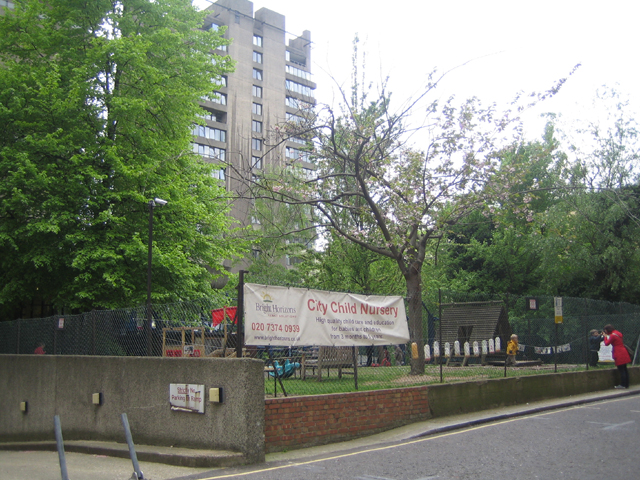
Bridgewater Square, May 2010. Photo: S Williams
2013 
2010 
Click a photo to enlarge.
Please note the Inventory and its content are provided for your general information only and are subject to change. It is your responsibility to check the accuracy.