
Christchurch Greyfriars Churchyard (City of London)
Brief Description
The former churchyard lies to the west of the Wren tower, all that remains of Christchurch Greyfriars. A Priory was established here in 1225, following the arrival from Italy of a group of Franciscan monks, called Greyfriars from the colour of their clothing. The Priory was later dissolved by Henry VIII but in 1546 the church and other Priory buildings became 'Christ Church within Newgate'. The church was destroyed in the Great Fire of 1666 and a new church by Christopher Wren completed in 1704. Smaller than the church it replaced, the remainder of the site to the west was enclosed as the burial ground. The walled and railed churchyard became a garden and public open space in 1872, and is largely grass, a few mature trees, two chest tombs and a number of headstones.
Practical Information
- Previous / Other name:
- Newgate Street Garden
- Site location:
- Newgate Street/Greyfriars Passage
- Postcode:
- EC1A 7BA
- What 3 Words:
- twin.aspect.sunk
- Type of site:
- Public Gardens
- Borough:
- City of London
- Open to public?
- Yes
- Opening times:
- unrestricted
- Special conditions:
- Facilities:
- Events:
- Public transport:
- Tube: St Paul's (Central)



- Research updated:
- 01/06/2010
- Last minor changes:
- 29/03/2026
Please check with the site owner or manager for latest news. www.cityoflondon.gov.uk/openspaces
Full Site Description
The former churchyard lies to the west of the Wren tower which is all that remains of Christchurch Greyfriars (q.v.). The Franciscan Church of Greyfriars was established in 1225, following the arrival from Italy in 1224 of nine monks of the Franciscan Order, called Greyfriars from the colour of their clothing. Four of the monks came to London, the remainder going to Canterbury. They first had a temporary establishment in Cornhill; as their influence grew, a mercer called John Ewin then bought them a piece of land in the parish of St Nicholas Shambles and various buildings were erected, one Lord Mayor of London building them a choir, another the body of a church. In 1306 building of a larger church commenced, with support from Edward I's second wife Margaret and other influential benefactors, the second largest medieval church in the City. Richard Whittington, Lord Mayor, founded a library here in 1429.
After the Dissolution the church was used to house spoils taken from the French, but in 1546 Henry VIII gave the various buildings of the Priory, together with the parish churches of St Ewin in Newgate Market and St Nicholas in the Shambles and part of that of St Sepulchre, to the Mayor and Corporation of London, to be formed into one parish of 'Christ's Church within Newgate, founded by Henry VIII' on condition that the Corporation provided a vicar and five priests, one to attend the prisoners at Newgate when required. The church was destroyed in the Great Fire of 1666 and rebuilding of a new church designed by Wren commenced in 1687, completed in 1704. At that time the parish of St Leonard Foster Lane, burnt down but not rebuilt, was added to the parish of Christ Church. Wren's church was smaller than the church it replaced, the remainder of the site to the west enclosed as the burial ground.
The walled and railed churchyard became a garden and public open space in 1872. From 1931 an annual grant was paid by the Corporation of London towards its maintenance as open space. The garden is largely grass, with a number of mature trees; there are two chest tombs and a number of headstones. A central path runs through the garden to gates on Greyfriars Passage in front of Vestry House and the remains of Christ Church.
Sources consulted:
B. Cherry and N. Pevsner, 'The Buildings of England, London Vol. l: The Cities of London and Westminster', London, 1985; Simon Bradley & Nikolaus Pevsner, 'The Buildings of England, London 1: The City of London', 1997 (1999 ed.); George Godwin & John Britton 'The Churches of London: A history and description of the Ecclesiastical Edifices of the Metropolis, Volume II', London, 1839; London Diocesan Advisory Committee for the Care of Churches data; B Plummer and D Shewan, 'City Gardens', London, 1992
Further Information (Planning and Conservation)
- Grid ref:
- TQ319813 (531950,181374)
- Size in hectares:
- 0.1231
- Site ownership:
- Diocese of London
- Site management:
- City of London Corporation, Open Spaces Dept.
- Date(s):
- 1680s; 1872
- Designer(s):
- Listed structures:
- LBI and SAM: Remains of Christ Church
- On National Heritage List for England (NHLE), Parks & Gardens:
No- Registered common or village green on Commons Registration Act 1965:
No- Protected under London Squares Preservation Act 1931:
No
Local Authority Data
The information below is taken from the relevant Local Authority's planning legislation, which was correct at the time of research but may have been amended in the interim. Please check with the Local Authority for latest planning information.
- On Local List:
- No
- In Conservation Area:
- No
- Tree Preservation Order:
- No
- Nature Conservation Area:
- No
- Green Belt:
- No
- Metropolitan Open Land:
- No
- Special Policy Area:
- Yes - St Paul's Heights Policy Area
- Other LA designation:
- Strategic Viewing Corridor
Photos
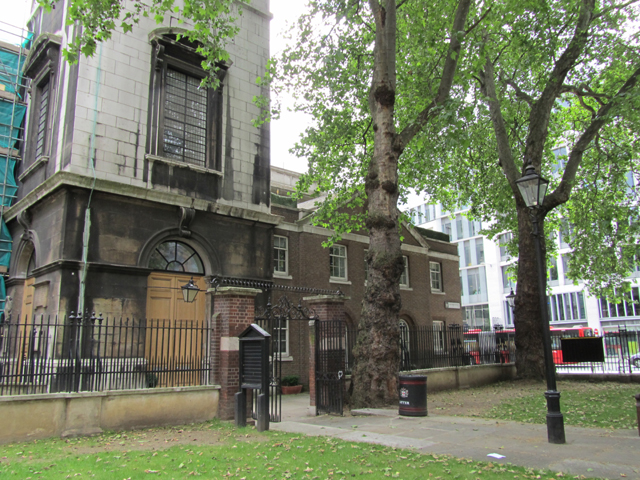
Christchurch Greyfriars Churchyard and remains of church, June 2010. Photo: S Williams
2010 
2010 
2010 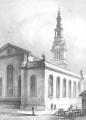
1838 Click a photo to enlarge.
Please note the Inventory and its content are provided for your general information only and are subject to change. It is your responsibility to check the accuracy.