
East Ham Jewish Cemetery (Newham)
Brief Description
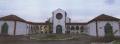
East Ham Jewish Cemetery was established in 1919 by the United Synagogue. Inside the main entrance is a small area of flowering shrubs, and there are pollarded limes along the two main axes, otherwise the whole area is laid out symmetrically with tarmac paths and gravestones set in gravel. There are some traditional classical funerary monuments or Matzevah. In 1924 a white painted brick prayer hall with cloister /colonnades was built in the centre of the cemetery. Next to this is a hedged war memorial of gravestones set in grass.
Practical Information
- Previous / Other name:
- Marlow Road Cemetery
- Site location:
- Marlow Road off Sandford Road, East Ham
- Postcode:
- E6 3QG
- What 3 Words:
- send.shells.sailor
- Type of site:
- Cemetery
- Borough:
- Newham
- Open to public?
- Yes
- Opening times:
- Sun-Thurs: 9am-3pm.Closed Shabbat and Jewish festivals, plus National and Bank Holidays
- Special conditions:
- Facilities:
- Toilets
- Events:
- Public transport:
- Tube: East Ham (District) then bus. DLR: Beckton then bus. Bus: 300, 104.



- Research updated:
- 16/03/2026
- Last minor changes:
- 29/03/2026
Please check with the site owner or manager for latest news. https://theus.org.uk/what-we-do/burial/our-cemeteries/
Full Site Description
Until the C20th swathes of land in in this area were almost entirely unbuilt over, largely comprising fields and marshland, a few settlements and the Northern Outfall Sewer, now known as The Greenway (q.v.) cutting across from west to east (see OS 25 ins Essex 1st Edition map LXXIII.16).
East Ham Jewish Cemetery was established here in 1919 by the United Synagogue Burial Society, a charity serving the British Jewish community that was created by Act of Parliament in 1870, but whose roots go back to 1690 when the Great Synagogue was founded in Duke's Place, which was destroyed in 1941 by bombing in the Blitz. The United Synagogue brought together five synagogues: the Great, Hambro, New, Central and Bayswater Synagogues, and its first joint burial ground to be established was Willesden Jewish Cemetery (q.v.) in 1873. East Ham Cemetery remains one of the 20 cemeteries maintained by the United Synagogue Burial Society today.
Also known as Marlow Road Cemetery, the cemetery is surrounded by a brick boundary wall; inside the main entrance is a small area of flowering shrubs, and there are pollarded limes along the two main axes, but otherwise the whole area is laid out symmetrically with tarmac paths and gravestones set in gravel. There are some traditional classical funerary monuments. In the centre of the cemetery is a white painted brick prayer hall or Ohel with cloister /colonnades designed by H W Ford in 1924, which is described by Meller as 'architecturally more suited to a Mediterranean seaside resort than a cemetery'. Next to the prayer hall is a hedged war memorial of gravestones set in grass. The cemetery entrance on Marlow Road had brick gate piers topped with stone and iron gates with the United Synagogue insignia.
Those buried in the cemetery include the founder of the London Jewish Hospital, Isidore Berliner (d.1925), and Solomon Mendeloff (d.1970) who as Ted 'Kid' Lewis was the world welter-weight boxing champion in 1915. Also buried here is 11 year-old Mark Rothstein, among the 134 victims of the Hughes Mansions disaster in Vallance Road, Stepney, the majority of whom were Jews, killed on 27 March 1945 by the last V2 rocket to fall on London at the end of World War II.
East Ham Cemetery is one of three Jewish cemeteries that were established in Newham, and the only cemetery that remains open, the others being West Ham Jewish Cemetery (1858-1965) in Buckingham Road, Forest Lane, and Plashet Cemetery, dating from 1896, closed by 2010.
Sources consulted:
Hugh Meller & Brian Parsons, 'London Cemeteries, An Illustrated Guide and Gazetteer', 4th edition (The History Press, 2008); https://theus.org.uk/what-we-do/burial/our-cemeteries/; https://theus.org.uk/assets/uploads/2023/10/East-Ham-Cemetery-maps-and-guides-v3-NB-F.pdf; https://www.thejc.com/news/features/the-seder-bombing-that-killed-my-mother-qaqrl3q3; Jewish Heritage in England: An Architectural Guide
Further Information (Planning and Conservation)
- Grid ref:
- TQ423825 (542350,182550)
- Size in hectares:
- Site ownership:
- The United Synagogue
- Site management:
- The United Synagogue
- Date(s):
- 1919
- Designer(s):
- Listed structures:
- None
- On National Heritage List for England (NHLE), Parks & Gardens:
No- Registered common or village green on Commons Registration Act 1965:
No- Protected under London Squares Preservation Act 1931:
No
Local Authority Data
The information below is taken from the relevant Local Authority's planning legislation, which was correct at the time of research but may have been amended in the interim. Please check with the Local Authority for latest planning information.
- On Local List:
- No
- In Conservation Area:
- No
- Tree Preservation Order:
- No
- Nature Conservation Area:
- No
- Green Belt:
- No
- Metropolitan Open Land:
- No
- Special Policy Area:
- No
- Other LA designation:
- None
Click a photo to enlarge.
Please note the Inventory and its content are provided for your general information only and are subject to change. It is your responsibility to check the accuracy.