
St Andrew-by-the-Wardrobe Churchyard (City of London)
Brief Description
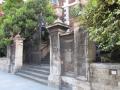
The church was first called St Andrew's juxta Baynard's Castle after a tower erected on the banks of the Thames by the Baynard family, who came to England with William the Conqueror. Baynard's Castle was later owned by the Crown and occasionally used as a Royal residence. St Andrew's later became known as St Andrew-by-the-Wardrobe due to the proximity of the Royal Wardrobe, which had moved from the Tower in the mid C14th to a site now Wardrobe Place north of the church. Baynard's Castle, the Wardrobe and St Andrew's were destroyed in the Great Fire of 1666, the church rebuilt in 1685-94 by Wren. The steep terraced churchyard that lies between the church front and Queen Victoria Street was laid out as a garden in 1901 when the front wall with urns and ornamental wrought iron gates were erected, presented in memory of church warden Professor Banister Fletcher.
Practical Information
- Site location:
- Queen Victoria Street/St Andrews Hill
- Postcode:
- EC4V 5DE
- What 3 Words:
- expert.sticky.keep
- Type of site:
- Public Gardens
- Borough:
- City of London
- Open to public?
- Yes
- Opening times:
- unrestricted. Church: Mon-Fri 10am-4pm
- Special conditions:
- Facilities:
- Events:
- Events in church
- Public transport:
- Tube: Blackfriars (District, Circle). Rail: Blackfriars



- Research updated:
- 01/06/2010
- Last minor changes:
- 08/04/2026
Please check with the site owner or manager for latest news. www.cityoflondon.gov.uk/openspaces
Full Site Description
St Andrew-by-the-Wardrobe was first called St Andrew's juxta Baynard's Castle after a tower erected during the reign of William I on the banks of the Thames by the Baynard family who came to England with William the Conqueror. In 1213 Baynard's Castle was in the possession of the Fitzwalter family together with land and houses around it and St Andrew's was probably founded at that time, the first reference to a rector being to a John de Castillo in 1261. Baynard's Castle was later owned by the Crown and occasionally used as a Royal residence, including by the Duke of Gloucester, later Richard III; a scene in Shakespeare's play 'Richard III' takes place here. St Andrew's later became known as St Andrew-by-the-Wardrobe due to the proximity of the Royal Wardrobe, which had moved from the Tower in the mid C14th to a site now Wardrobe Place (q.v.) north of the church. Baynard's Castle, the Wardrobe and St Andrew's were destroyed in the Great Fire of 1666, the church rebuilt in 1685-94 by Wren. The parish then amalgamated with St Anne Blackfriars which was not rebuilt and whose site then became a burial ground, which survives at Church Entry and Ireland Yard (q.v.). St Andrew's was later badly damaged in 1940 when most of the internal furnishings were destroyed, after which it was restored in 1959-61.
Much of the churchyard to the south was lost when Queen Victoria Street was laid out in 1871, and the steep terraced garden that lies between the church front and Queen Victoria Street was laid out in 1901 when the front wall with urns and ornamental wrought iron gates were erected, presented by his family in memory of Professor Banister Fletcher, a past church warden. A crucifix by Walter Tapper is located in this sloping garden. At the north side of the church is a paved area with seats and tubs, all that remains of the churchyard to the north. An engraving of c.1839 shows the church with railings to the south.
Among those buried here with fine memorials in the church is Rev W. Goode (d.1816) who was a curate of the parish from 1786 and vicar from 1795. He established a soup kitchen in Blackfriars in 1799, which was the origin of the 'Association for the relief of the poor in the City of London' and in 1809 he formed a Sunday School, probably the first to be opened in the City.
Sources consulted:
B. Cherry and N. Pevsner, 'The Buildings of England, London Vol. l: The Cities of London and Westminster', London, 1985; Simon Bradley & Nikolaus Pevsner, 'The Buildings of England, London 1: The City of London', 1997 (1999 ed.); George Godwin & John Britton 'The Churches of London: A history and description of the Ecclesiastical Edifices of the Metropolis, Volume II', London, 1839; Philip Norman, 'The London City Churches, Their Use, Their Preservation and Their Extended Use', The London Society, (1920s); London Diocesan Advisory Committee for the Care of Churches data
Further Information (Planning and Conservation)
- Grid ref:
- TQ318810 (531843,180966)
- Size in hectares:
- 0.0228
- Site ownership:
- Diocese of London
- Site management:
- City of London Corporation Open Spaces Dept
- Date(s):
- C13th, 1685-93, 1859-61
- Designer(s):
- Listed structures:
- LBI: St Andrew's Church
- On National Heritage List for England (NHLE), Parks & Gardens:
No- Registered common or village green on Commons Registration Act 1965:
No- Protected under London Squares Preservation Act 1931:
No
Local Authority Data
The information below is taken from the relevant Local Authority's planning legislation, which was correct at the time of research but may have been amended in the interim. Please check with the Local Authority for latest planning information.
- On Local List:
- No
- In Conservation Area:
- Yes
- Conservation Area name:
- St Paul's Cathedral
- Tree Preservation Order:
- No
- Nature Conservation Area:
- No
- Green Belt:
- No
- Metropolitan Open Land:
- No
- Special Policy Area:
- Yes - St Paul's Heights Policy Area
- Other LA designation:
- Strategic Viewing Corridor
Photos

St Andrew-by-the-Wardrobe, June 2010. Photo: S Williams
2010 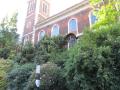
2010 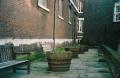
2002 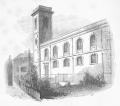
1838 Click a photo to enlarge.
Please note the Inventory and its content are provided for your general information only and are subject to change. It is your responsibility to check the accuracy.