
St Bride's Fleet Street Churchyard (City of London)
Brief Description
The church is dedicated to the C5th Irish St Bride or Bridget and has existed here for some 1500 years, possibly the first place in London where Christianity was practiced. The old church was destroyed in the Great Fire in 1666 and the current building is the eighth on the site, rebuilt by Wren by 1680. Its spire, once higher, was completed in 1703, the highest of Wren's steeples and apparently the inspiration for the first tiered wedding cake. It is known as the Printers Cathedral or Journalists Church after the first printing press with moveable type was brought here in 1500. Many famous people are connected with the church including John Milton, Samuel Pepys, Samuel Johnson and Charles Dickens. On the north side of the church the raised railed churchyard has a number of mature trees, areas of paving and seats, with gravestones set into the ground.
Practical Information
- Site location:
- Fleet Street/Bride Lane/St Bride's Passage
- Postcode:
- EC4Y 8AU
- What 3 Words:
- analogy.shady.fake
- Type of site:
- Public Gardens
- Borough:
- City of London
- Open to public?
- Yes
- Opening times:
- Mon-Sat 8am-5pm, Sun 10am-12.30pm and 5.30-7.30pm
- Special conditions:
- Facilities:
- Events:
- lunch-time recitals and events in church
- Public transport:
- Tube: Blackfriars (District, Circle). Rail: Blackfriars



- Research updated:
- 01/06/2010
- Last minor changes:
- 29/03/2026
Please check with the site owner or manager for latest news. www.cityoflondon.gov.uk/openspaces; www.stbrides.com
Full Site Description
A church has existed on this site for some 1500 years, and it claims to be the first place in London where Christianity was practiced. The dedication is to the C5th Irish St Bride or Bridget. There was a churchyard here by 1188. Until c.1529 it was a rectory belonging to the Abbot and Convent of Westminster. After Dissolution of the Convent, Westminster was formed into a bishopric and St Bride's was bestowed on the new diocesan. In 1610 the Earl of Dorset gave the parish land on the west of Farringdon Street for a cemetery on condition that burials should not take place on the south side of the church that faced his mansion. When this was destroyed in the Great Fire of 1666 the parish was released from this restriction. The old church was also destroyed in the Great Fire and the current building is the eighth on the site, rebuilt by Wren by 1680, the marble font of 1615 all that remained from the old building. The spire was not completed until 1703, the highest of Wren's steeples and apparently the inspiration for the first tiered wedding cake; originally 234 feet above ground level, it was badly damaged by lightning in June 1764 and was lowered by 8 feet during repairs. The view of the church from Fleet Street was originally blocked by houses. St Bride's Avenue was created in 1825 when, the houses having been destroyed in a fire, land between the church and Fleet Street was purchased by public subscription and the passageway made, designed by J B Papworth specifically to provide this view.
St Bride's is known as the Printers Cathedral and the Journalists Church due to the fact that the first printing press with moveable type was brought here in 1500. Famous people connected with the church include John Milton who apparently lived in the churchyard, Samuel Pepys was baptised here, Samuel Johnson and Charles Dickens lived nearby; King John held several councils in the church. Among those buried in the old church were Wynkyn de Worde, a noted printer in the time of Henry VII, Sir Richard Baker who wrote 'Chronicles of the Kings of England' (d.1644), Richard Lovelace and the novelist Samuel Richardson (d.1761). During the Plague many parishioners died, with some 1491 people were buried in the churchyard between August and October 1665. The parents of Virginia Dare, the first European child be to born in Colonial America in 1587, were married at St Bride's.
Near the church at one time was one of London's many 'holy wells', named St Bride's Well, after which the hospital nearby founded by Edward VI was named, later to become Bridewell House of Correction. The site of the well was marked by an iron pump in a niche below the raised burial ground at the east end of the church.
The Wren church was gutted by bombing in 1940 and subsequently restored, at which time church crypts were discovered. On the north side of the church is the raised railed churchyard, which has a number of trees, areas of paving and seats. The gates at the main entrance off Fleet Street were erected by The Newspaper Society in memory of Valentine Knapp, President of the Society 1919-1922.
Sources consulted:
B. Cherry and N. Pevsner, 'The Buildings of England, London Vol. l: The Cities of London and Westminster', London, 1985; George Godwin & John Britton 'The Churches of London: A history and description of the Ecclesiastical Edifices of the Metropolis, Volume II', London, 1839; Simon Bradley & Nikolaus Pevsner, 'The Buildings of England, London 1: The City of London', 1997 (1999 ed.); Philip Norman, 'The London City Churches, Their Use, Their Preservation and Their Extended Use', The London Society, (1920s); churchboard on site; London Diocesan Advisory Committee for the Care of Churches data.
Further Information (Planning and Conservation)
- Grid ref:
- TQ315811 (531538,181105)
- Size in hectares:
- 0.0924
- Site ownership:
- Diocese of London
- Site management:
- City of London Corporation Open Spaces Dept
- Date(s):
- C12th onwards
- Designer(s):
- Listed structures:
- LBI: St Bride's Church. LBII: St Bride Foundation Institute and Library in Bride Lane
- On National Heritage List for England (NHLE), Parks & Gardens:
No- Registered common or village green on Commons Registration Act 1965:
No- Protected under London Squares Preservation Act 1931:
No
Local Authority Data
The information below is taken from the relevant Local Authority's planning legislation, which was correct at the time of research but may have been amended in the interim. Please check with the Local Authority for latest planning information.
- On Local List:
- No
- In Conservation Area:
- Yes
- Conservation Area name:
- Fleet Street
- Tree Preservation Order:
- No
- Nature Conservation Area:
- No
- Green Belt:
- No
- Metropolitan Open Land:
- No
- Special Policy Area:
- No
- Other LA designation:
- Strategic View - Consultation Area
Photos

St Bride's Fleet Street from the south, June 2010. Photo: S Williams

2011 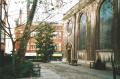
2002 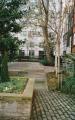
2002 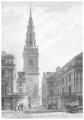
1839 Click a photo to enlarge.
Please note the Inventory and its content are provided for your general information only and are subject to change. It is your responsibility to check the accuracy.