
Charlton Cemetery (Greenwich)
Brief Description
Charlton Cemetery was founded in 1855 by Charlton Burial Board on land that was originally part of the estate of Sir Thomas Maryon Wilson. It was one of the first cemeteries to be provided under the new Burial Act. Its Victorian layout of serpentine paths is little changed and it retains the pair of C19th chapels although the original lodge has gone. Among the memorials are numerous monuments to the army and navy and personnel connected with the Royal Artillery at Woolwich and other notable people including Sir Geoffrey Callender, the first Director of the National Maritime Museum, and Sir John Maryon-Wilson, Lord of the Manor of Hampstead who was instrumental in the preservation of Hampstead Heath.
Practical Information
- Site location:
- Cemetery Lane, Charlton
- Postcode:
- SE7 8DZ
- What 3 Words:
- transit.wiring.appeal
- Type of site:
- Cemetery
- Borough:
- Greenwich
- Open to public?
- Yes
- Opening times:
- Daily April-Sept 9am-7pm; Oct-Mar 9am-4pm
- Special conditions:
- No dogs except guide dogs
- Facilities:
- Toilets
- Events:
- Public transport:
- Rail: Charlton then bus. Bus: 53, 54, 422, 486 (walk)



- Research updated:
- 01/12/2006
- Last minor changes:
- 19/07/2023
Please check with the site owner or manager for latest news. www.royalgreenwich.gov.uk
Full Site Description
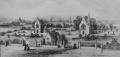
The cemetery was founded in 1855 as an exclusive 8-acre "Gentleman's Cemetery" by Charlton Burial Board on land which was originally part of the estate of Sir Thomas Maryon Wilson. According to an article in the Illustrated London News in 1857, the land was purchased 'for a considerable sum, on account of its superiority and peculiar advantages as regards contiguity to the parish, fine soil, easy access, &c.' The article goes on to describe the cemetery layout and buildings: 'The ground is laid out and planted with trees, shrubs, &c., of a choice description, a portion being set apart for the use of Dissenters, and is inclosed on the front side with a dwarf plinth-wall of red brick and Portland stone in character with the rest of the architecture, and a neat iron palisading on the top. Separate entrances and carriage-gates are provided to the Episcopal and Dissenters' portion of the ground.' The chapels, positioned on the rising ground, were 'seen to advantage from the public road.' Details of the contract are also given: 'The contracts of the laying out, building chapels, lodge, entrance-gates, and front wall, amounted to £2612; the whole being carried out under the direction of Mr. S. Hewitt, architect, of Southwark.'
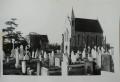
The cemetery was later expanded by a further 7 acres in the C20th. The layout has serpentine paths, and is much the same today as the Victorian layout shown in the drawing in the 'Illustrated London News' in 1857. The pair of C19th chapels remain; the Church of England chapel is Early English style and has a stained glass west window showing the Entombment, which was presented in 1865 by the local vicar; the Roman Catholic Chapel is in Decorated style. The cemetery's original stone-capped walls topped with railings remain and a tile-hung lodge although the original lodge was demolished. Planting is a little sparse and apart from some holm oaks, it lacks large trees but good recent planting includes monkey puzzle and larch.
Among the memorials are numerous monuments to the army and navy and personnel connected with the Royal Artillery at Woolwich, including Admiral Sir Watkin Pell (d.1869) who served with Lord Nelson; Admiral George Perceval, 6th Earl of Egmont (d.1874) a midshipman at the Battle of Trafalgar in 1805, and who had once owned Charlton House; and Sir William Dalyell (d.1865) who fought in the Napoleonic wars. Others notable people buried are Governors of Malta, Bermuda, Gibraltar, and the commander in Chief of India; Sir Geoffrey Callender (d.1945), the first Director of the National Maritime Museum, and Sir John Maryon-Wilson (1802-1876), Lord of the Manor of Hampstead who was instrumental in the preservation of Hampstead Heath (q.v.), and whose family owned the land that is now Maryon and Maryon Wilson Parks (q.v.). An urn on a large plinth commemorated the death of 52 men and boys who died of yellow fever on board the HMS Firebrand in July 1861. Near the entrance is the memorial to Jemima Ayley (d.1860) whose effigy lies under a domed canopy below which is a 22ft vault containing a table and chair used by mourning relatives. The memorial of Thomas Murphy (d.1932), the owner of Charlton greyhound track, has a pair of greyhounds at the foot of Corinthian columns; other exceptional memorials include that to Major-General Orde Wingate RA (Chindits) and the 'Two Brides'.
A granite drinking fountain with circular bowl was re-located in the cemetery in 1979, but was originally at the junction of Charlton Way and Duke Humphrey Road, presented by the Metropolitan Drinking Fountain and Cattle Trough Association in 1901.
Sources consulted:
Hugh Meller & Brian Parsons, 'London Cemeteries, An Illustrated Guide and Gazetteer', 4th edition (The History Press, 2008); Illustrated London News, 1857 (see Greenwich Local Studies and Archive Centre)
Further Information (Planning and Conservation)
- Grid ref:
- TQ423777 (542436,177772)
- Size in hectares:
- 5.87
- Site ownership:
- RB Greenwich
- Site management:
- Parks and Open Spaces Department
- Date(s):
- 1855
- Designer(s):
- Listed structures:
- Local List: Drinking fountain
- On National Heritage List for England (NHLE), Parks & Gardens:
No- Registered common or village green on Commons Registration Act 1965:
No- Protected under London Squares Preservation Act 1931:
No
Local Authority Data
The information below is taken from the relevant Local Authority's planning legislation, which was correct at the time of research but may have been amended in the interim. Please check with the Local Authority for latest planning information.
- On Local List:
- No
- In Conservation Area:
- Yes
- Conservation Area name:
- Woolwich Common
- Tree Preservation Order:
- Not known
- Nature Conservation Area:
- No
- Green Belt:
- No
- Metropolitan Open Land:
- Yes
- Special Policy Area:
- Yes - Area of Special Character of Metropolitan Importance
- Other LA designation:
- adjacent to Green Chain walk
1857 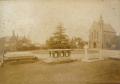
Click a photo to enlarge.
Please note the Inventory and its content are provided for your general information only and are subject to change. It is your responsibility to check the accuracy.