
Research volunteer Philippa Drew reveals some of the artwork found in our parks created by artists who had migrated to London
The definition, from the Oxford Learner Dictionary of an immigrant, is a person who
has come to live permanently in a different country to the one in which they were
born. Coined in the 17th century, the term referred to non-warlike population movements between emerging nation states.
Today, international migration has moved centre stage in political, policy, and
public discussions in countries around the world. There are many
reasons why people have decided or been forced to move their life to another
country, both currently and historically. For example, to study, to marry, or in flight from poverty, war and discrimination.
Migrants have contributed to London’s parks and gardens in many different areas –
for example; plant introductions, horticultural practices, commemorations and art
work.
The definition of art, also from the Oxford Learner Dictionary, is the use of the
imagination to express ideas or feelings, particularly in painting, drawing or
sculpture. Artists produce works to be appreciated primarily for their beauty and/or
emotional power.
There are more than three thousand parks, green and open spaces in London including eight Royal Parks. There are many pieces of art in these spaces, some permanent, some temporary.
Sculpture, painting and decoration connect the physical world with culture, human interaction and experience. I have been researching immigrant artists and this article focuses on a very small sample of them and their contribution to London’s parks and gardens. I have broadened the remit to include public open spaces in a few examples.
Overall, I discovered thirteen artists, mostly sculptors, from eight different countries of origin, with four of those fleeing from countries which have been invaded by a foreign power, who have experienced discrimination and/or persecution.
I’ve looked briefly into some of them, their history and what led them to move to the
UK. As I was learning about these artists, some well-known, some that I had not heard of, I noticed themes were emerging within the context of their contribution and influence. These themes had some resonance to me and I hope to others.
They are broadly speaking cultural, interactive and physical. For some of the artists I’ve been able to find their own motivation for their piece of art; how they hoped their art might influence the development of parks and gardens in London; and what it may have contributed or represented to local communities.
I have been thinking about how the artists might influence values, traditions, beliefs
and history that can initially inform, and then change, established perceptions about
their own culture including colonial history, women’s roles, the celebration of heroes, the inspiration for the underprivileged and a way of challenging the norm.
I have put the photos first so there is a picture in the readers’ heads as they read.
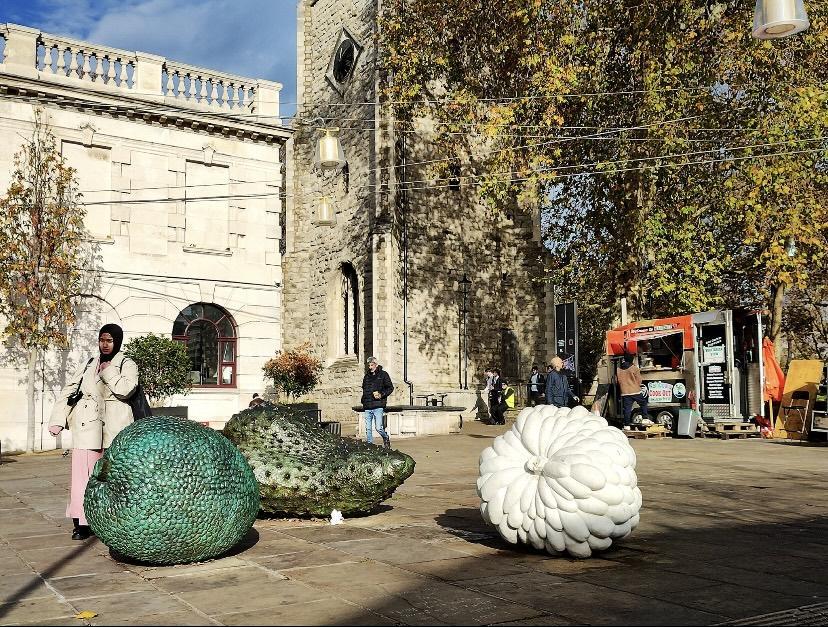
Caribbean Fruit – Veronica Ryan
© Barbara Deason 2025
The first example is Veronica Maudlyn Ryan’s Caribbean Fruit – her giant marble and
bronze sculptures of Caribbean fruits on Walled Garden Walk, an open space
adjacent to St. John’s Churchyard Gardens in Hackney East London.
They were commissioned by Hackney Council in collaboration with Create London,
and made possible through contributions by the Art Fund and Freelands Foundation
support. They were commissioned as a permanent symbol of honour, respect and
commitment to the Windrush Generation, its’ legacy and contribution to life in
Hackney today and was the first permanent public artwork to honour it.
They serve as a tactile experience with the opportunity to touch the pieces on the
way to the shops and are integral to marking colonial history and highlighting the
roles of women in society and in domesticity.
Ryan won the Turner Prize for this piece in 2022. The judges said they had been
struck by the “exquisite sensuality and tactility of the work bringing imagination and
accessibility to the heart of community life in the borough.”
The pieces were shown briefly in the background of a BBC television drama about
the Caribbean community in London, bringing them to a wider audience.
Veronica Maudlyn Ryan OBE, born 1956 in Montserrat, moved to London
with her parents as an infant.
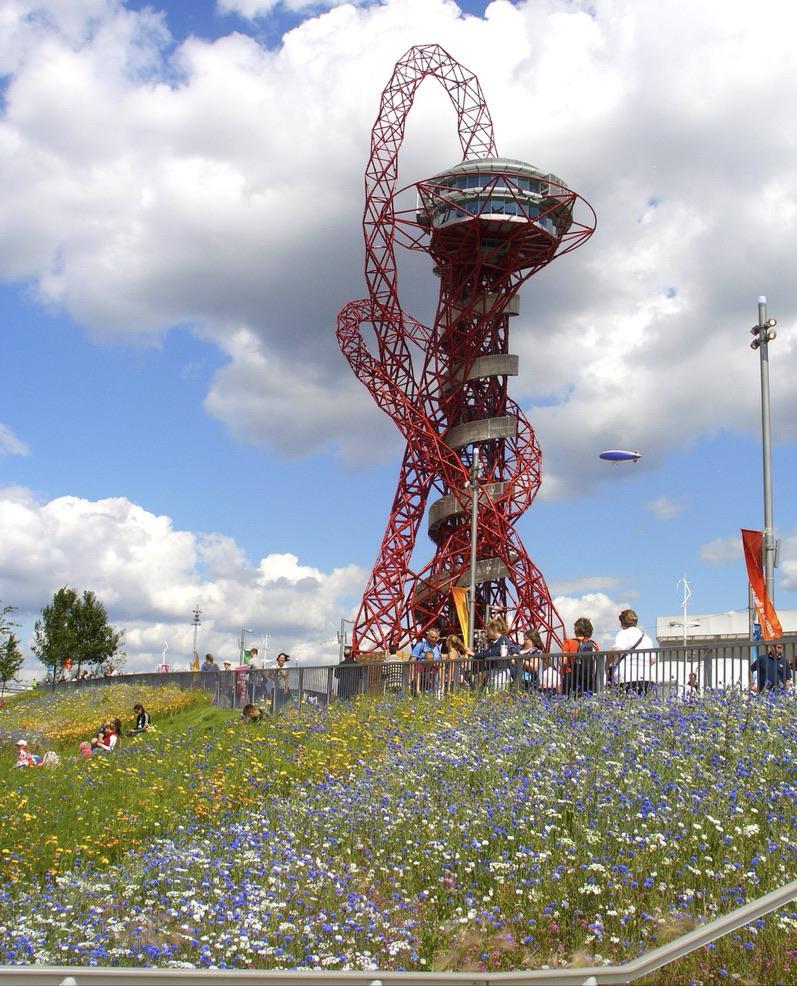
ArcelorMittal Orbit: Queen Elizabeth Olympic Park – Anish Kapoor
© Barbara Deason, 2012
Tactile intervention, sensuality, accessibility and imagination are all incorporated in
Anish Kapoor’s ArcelorMittal Orbit in London’s 2012 Olympic Park in East London.
The Queen Elizabeth Olympic Park was the first Olympic park to integrate artworks
into the landscape from the beginning.
The plan to build the piece came from a chance conversation between former
London Mayor, Boris Johnson and Lakshmi Mittal, Executive Chairman of the world’s
largest steel company ArcelorMittal. It was precision-built by a team of 100 staff in
Bolton, Lancashire and assembled on site by a crane and four men.
Kapoor is known for his use of abstract biomorphic form and he has a penchant for
rich colours and polished surfaces. In 1979 he returned to India and that visit
sparked new inspiration in his use of colours and shapes.
Anish Kapoor was born in India in 1954 into a diverse heritage from his Iraqi,
Jewish Punjabi and Hindu Parents. He moved to the United Kingdom in 1973 to
begin his art training at Hornsey College of Art and, later, Chelsea School of
Art and Design. He has lived and worked in London ever since.
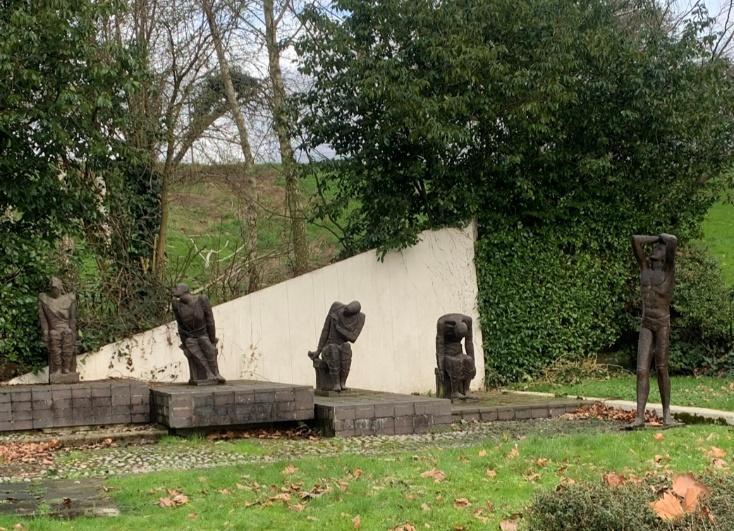
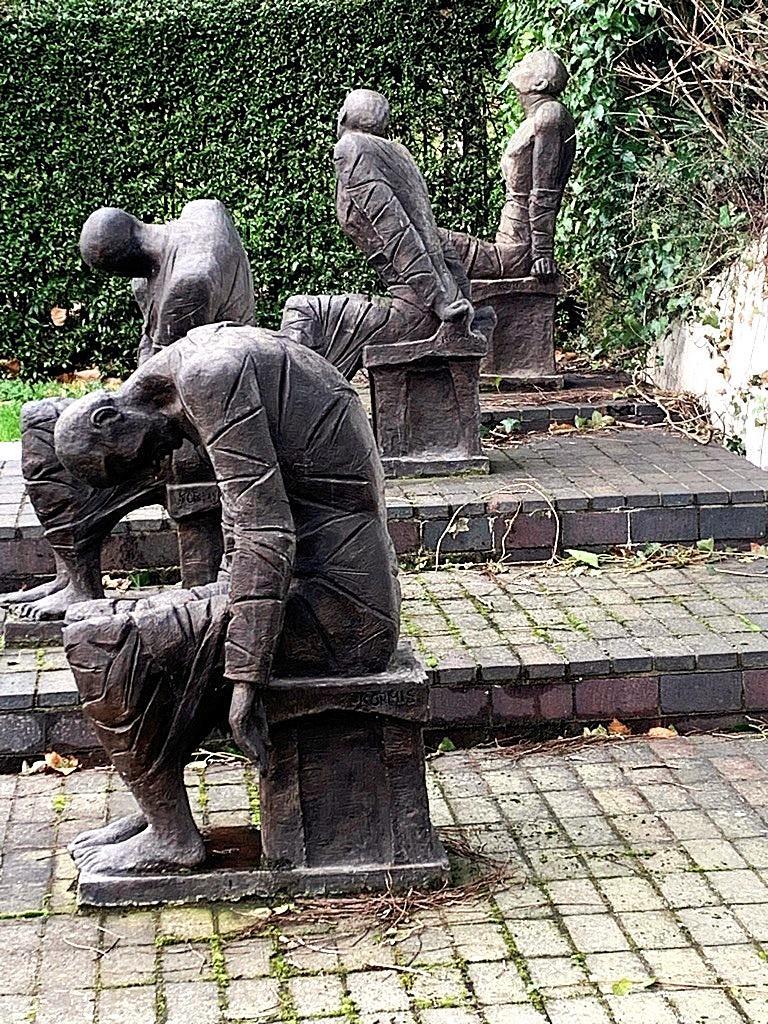
Memorial to Prisoners of War and Concentration Camp Victims – Fritz (Fred) Kormis
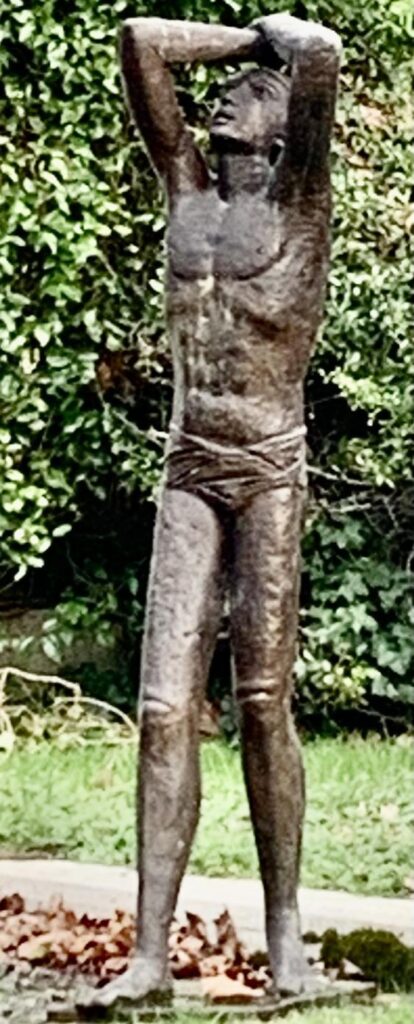

Images (c) Philippa Drew, 2024
In Queen’s Park, Kormis has another sculpture: Angel Wings, donated by his friend and Leader of Brent Council, Reg Freeson, in 2006. It stands in the south east corner of the park, almost covered by shrubs.
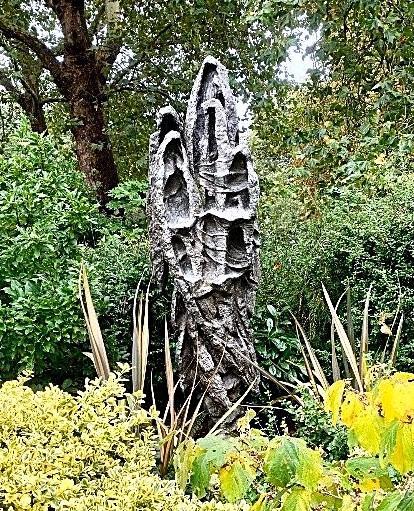
© Philippa Drew 2024
Connection to physical and emotional experiences is an integral part of the cultural
influence and historical information shown in the Memorial to Prisoners of War and
Concentration Camp Victims by Fritz Kormis, 1968/70. These figures are sited in
Gladstone Park, Brent which was the parkland of the former Dollis Hill House, built in 1825 by Earl of Aberdeen.
The land was acquired by Willesden Council in 1878 and renamed Gladstone Park
after Gladstone, leader of the Liberal party. He often stayed at the house declaring it
to be his favourite place to stay.
Kormis wanted the work to be erected in a depressed area to act as an incentive to
continue improvements, assisted in this aim by his friend Reg Freeson, then leader
of Brent Council. His intention was to show the figures going through stages of emotional expression which he had experienced himself and had observed in others:
The First. In stupor after Capture
The Second. Longing for Freedom
The Third. Fight against Gloom
The Fourth. Hope Lost
The Fifth. Hope again
The figures were seriously vandalised in 2003 and decapitated, a search revealed four of the vandalized heads thrown into surrounding undergrowth. Money from the Heritage Lottery Fund was made available to fully restore the memorial.
One head was missing but archive material allowed it to be replicated. Under expert
guidance the figures were split open, foam filler removed and their internal structure replaced with stainless steel. The black paint was cleaned off and their original bronze finish restored, the resulting increase in definition allowing their features to be clearly seen for the first time in many years. It is now fenced off so a tactile experience is no longer possible.
Fritz (Fred) Kormis was born of Czech parents in Frankfurt in 1897. He came to
England in 1934 and lived for almost fifty years in North London.
The Lovers – Georg Ehrlich
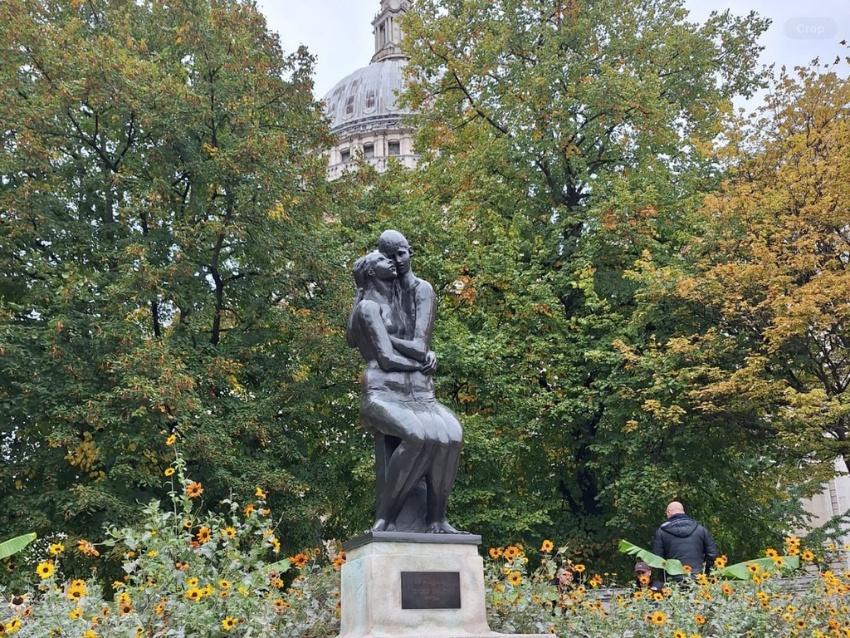
© James Drew 2025
Physicality and human emotions are evident in the life-size bronze sculpture by
Georg Ehrlich, created in the early 1950’s and installed in 1973. In 1969 the
Corporation of the City of London’s Trees, Gardens and City Open Spaces
Committee had set up a new fund to enable it to acquire sculptures and its first
purchase was ‘The Lovers’. It depicts a young couple, both naked, seated
side-by-side, located at the centre of Festival Gardens in the shadow of St. Paul’s
Cathedral, in the centre of London’s financial district.
The girl has both her arms wrapped around the man’s waist and he has his left arm
across the girl’s stomach with his hand under her left armpit. His right hand is at the
girl’s back with his hand caressing the girl’s neck. Their cheeks are resting against
each other. Seen on a daily basis by city commuters en route to work it has been
described as representing peace and love amongst the madness of city life
surrounding them.
Georg Ehrlich was born in Vienna in 1897. Jewish, he fled to London in 1938
after the Nazi Anschluss. In 1940 he was interned as an enemy alien on the Isle
of Man.
To Find a Way Home – Li Li Ren
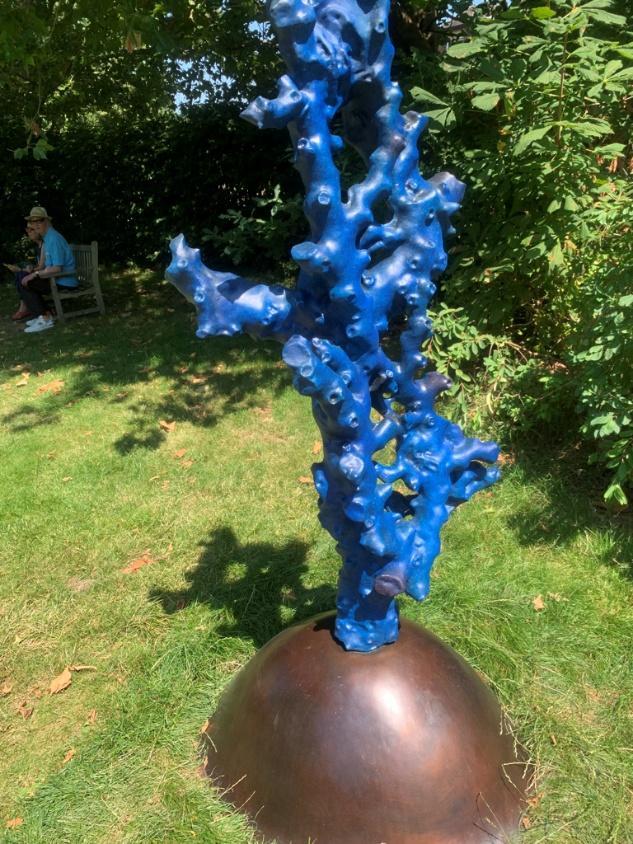
Images © Philippa Drew 2024
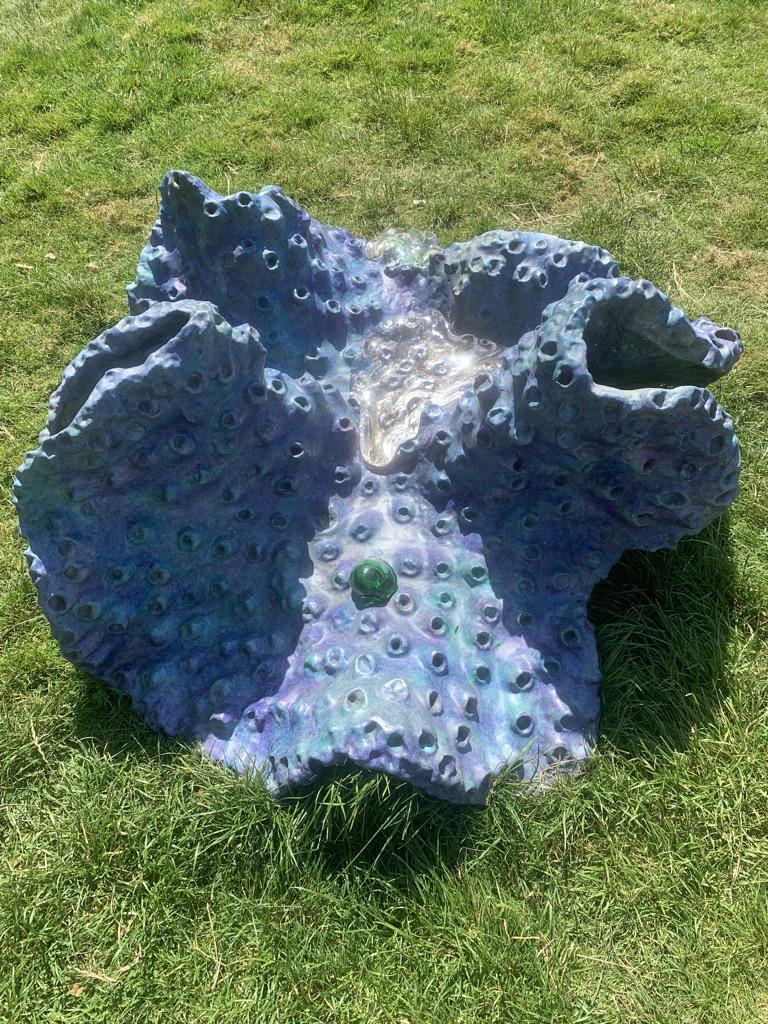
The intention of Li Li Ren is to cultivate physical interaction, intimate moments and
connections amongst both adults and children through her bronze, patina and glass
installation in Dulwich Picture Gallery Gardens – To Find a Way Home.
The gallery’s broad vision is to create an accessible, interactive and sensory-led
experience in the redevelopment of its grounds which includes a sculpture park.
Ren is an artist who uses materials, both soft and ethereal, hard and heavy to
invite touch and observation. She is interested in the psychological effects of bodily
forms evoking the viewers’ emotions. They provide a form of escapism in the
dreamlike shapes of her sculptures which resemble sea creatures and
underwater plant life. An interesting juxtaposition in a city park many miles from the sea.
Li Li Ren was born in China in 1986. She came to study at Central St Martins and the Royal College of Art and now lives and works in London.
Temporal Trace: Queen Elizabeth Olympic Path – Lubna Chowdhary
© Barbara Deason 2025
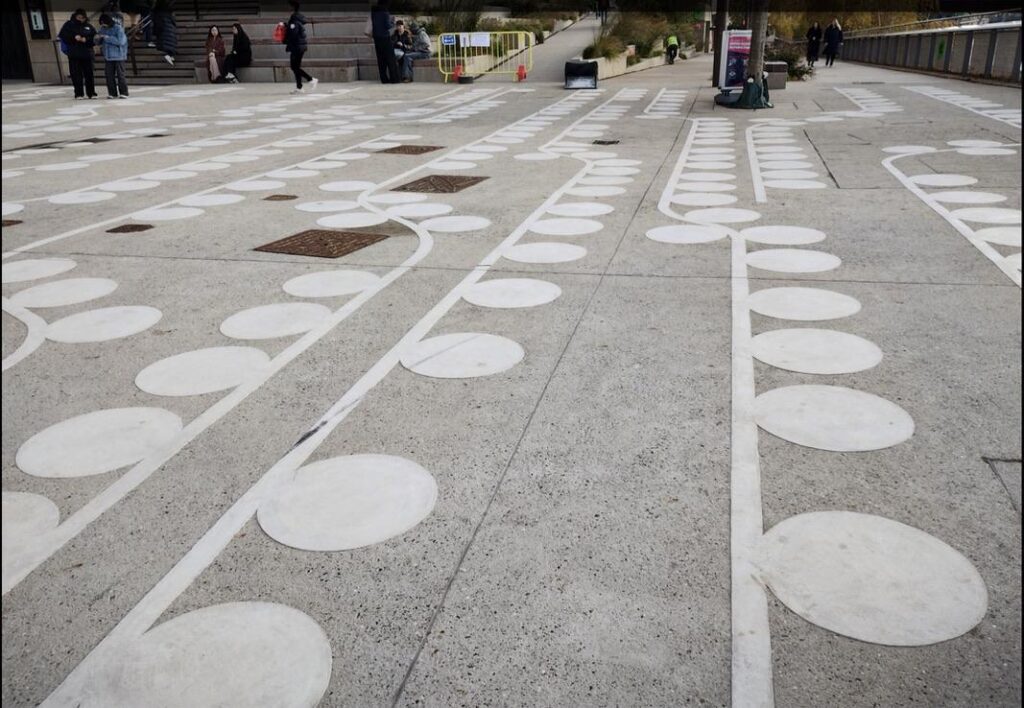
To celebrate a form of traditional culturally decorative art, Lubna Chowdhary gives a
very specific example in her interpretation of the south Indian Ritual of Kolam in the
Queen Elizabeth Olympic Park – Temporal Trace.
The ritual consists of the creation of geometrical lines, curves and loops using rice flour or stone powder around a grid pattern of dots. These are usually made by women, (though not exclusively) with the belief the patterns will bring prosperity, ward off evil and act as a welcome for their guests and the divine. The ritual serves as a form of physical and mental exercise to the creator, with the rice flour offering nourishment to ants and birds, creating a harmonious connection with nature.
The transient nature of the Kolam is central to the meaning as the patterns are
meant to be walked on, blown or washed away by the wind and rain and then
renewed the next day. A symbol of impermanence and renewal. This work takes
inspiration from and contributes to the activities which happen across the park,
including musical notation, textile design pattern-making and dance choreography.
An eclectic connection to current activities across cultures. Temporal Trace was commissioned by the London Dockland Development Corporation.
There is also one of her installations in the Market Square in Brentford with similar
patterns.
Lubna Chowdhary was born in 1964 in Tanzania to Pakistani parents. She moved to live in England in 1970 to study at the Royal College of Art and has lived here since she graduated.
The Neighbours – Siegfried Charoux
Iamges © Barbara Deason 2025
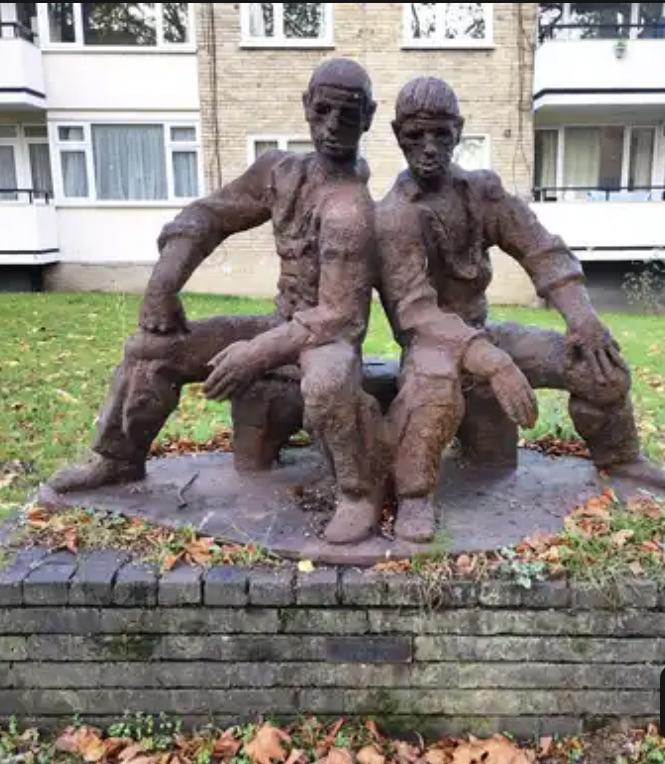
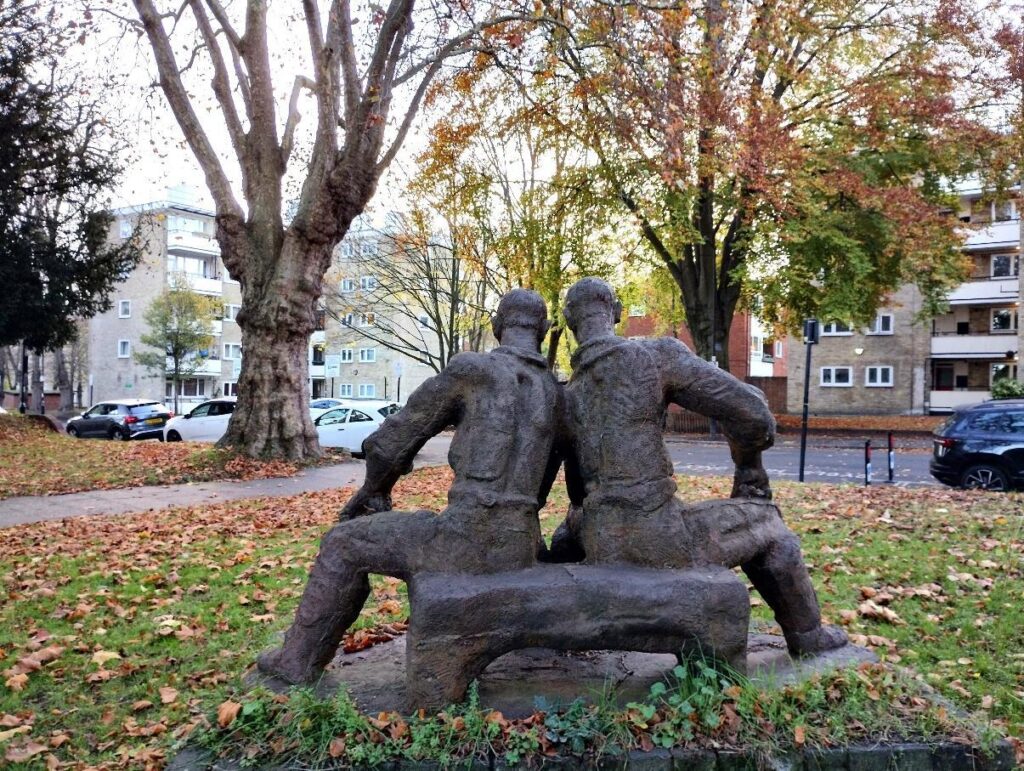
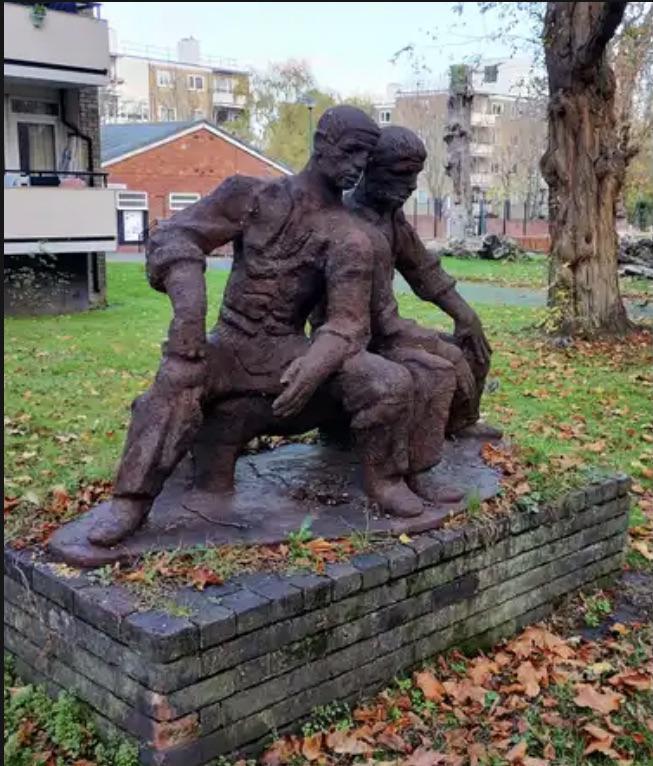
Social interaction and a sense of community were perhaps the intentions of Siegfried
Charoux when he created The Neighbours for the Quadrant Estate in Highbury
unveiled in 1959. This is a green space rather than a park or garden.
It is a sculpture of two working men sitting side by side on a bench, with shirt sleeves
rolled up. It was commissioned by the LCC as part of a public art programme and to
promote community spirit in a new housing estate. It was one of the first works to be
displayed on a public housing estate and is Grade II Listed.
The materials used are cemented iron or synthetic resin mixed with powdered stones, supported by a steel armature and fiberglass matting.
Charoux’s work became resonant with a political freedom the art critic David Sylvester described as ‘an aspiration for freedom and singularity’.
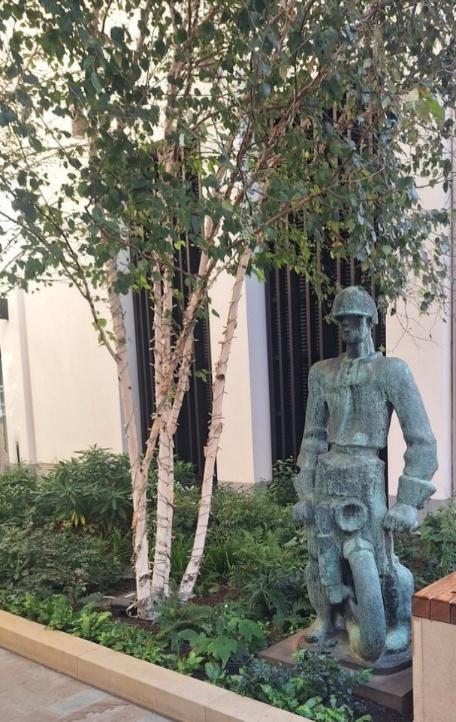
In a small garden area to the side of the new Shell building in Chichely Street, is another of his sculptures, The Motorcyclist.
(c) James Drew
Siegfried Joseph Charoux was born in Austria in 1896. He and his wife moved to England in 1935 after life became too difficult due to his left-wing views. He was interned on the Isle of Man during the Second World War.
The Leaning Woman – Karel Vogel
© Heritage of London Trust
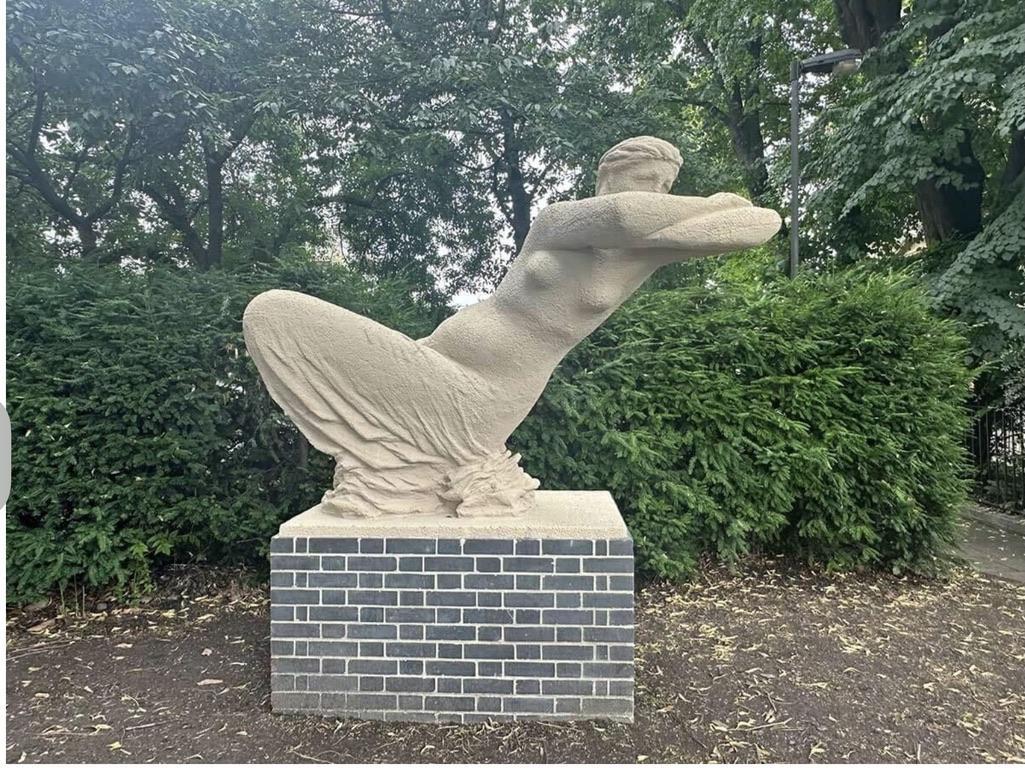
The Leaning Woman, near St Peter’s Church, Hammersmith, W6, is a semi-nude
classical Greek figure doing a sideways limbo movement. It was commissioned by
the old LCC to compensate the Hammersmith residents for the intrusion of the new
multiple carriageway – The Great West road. Her arms rest lightly on an absent
surface and her weight is cantilevered from the base. Her floating appearance linked
her surroundings ‘in neo-classical calm with the swiftness of the fast modern world’.
Motorists joked she was leaning forward to warn them to keep their speed down.
Over decades the concrete cracked and there were signs of rust where the
armature had been exposed.
More than 250 pupils from local schools across the borough have been involved in
restoring the sculpture through the Heritage of London Trust’s Proud Places youth
programme. This project provided on-site visits and training in heritage skills with
conservators and creative workshops. It also inspired them to create their own works of art based on the Leaning Woman.

A student from Westside School working on the restoration. © Heritage of London Trust
The restored statue was unveiled by HRH The Duke of Gloucester in July 2024, as part of a public event to celebrate the completion of the project.
Karel Vogel. 1897-1961 was born in Prague, fled from Czechoslovakia to
London in 1938 after the Nazi invasion. He became Principal of the sculpture
school at Camberwell School of Art.
The following two artists created two very different installations; both have been
removed since I started this research. I have included them because I found them
inspirational.
Catching Colour – Rana Begum

Images © Barbara Deason, 2024
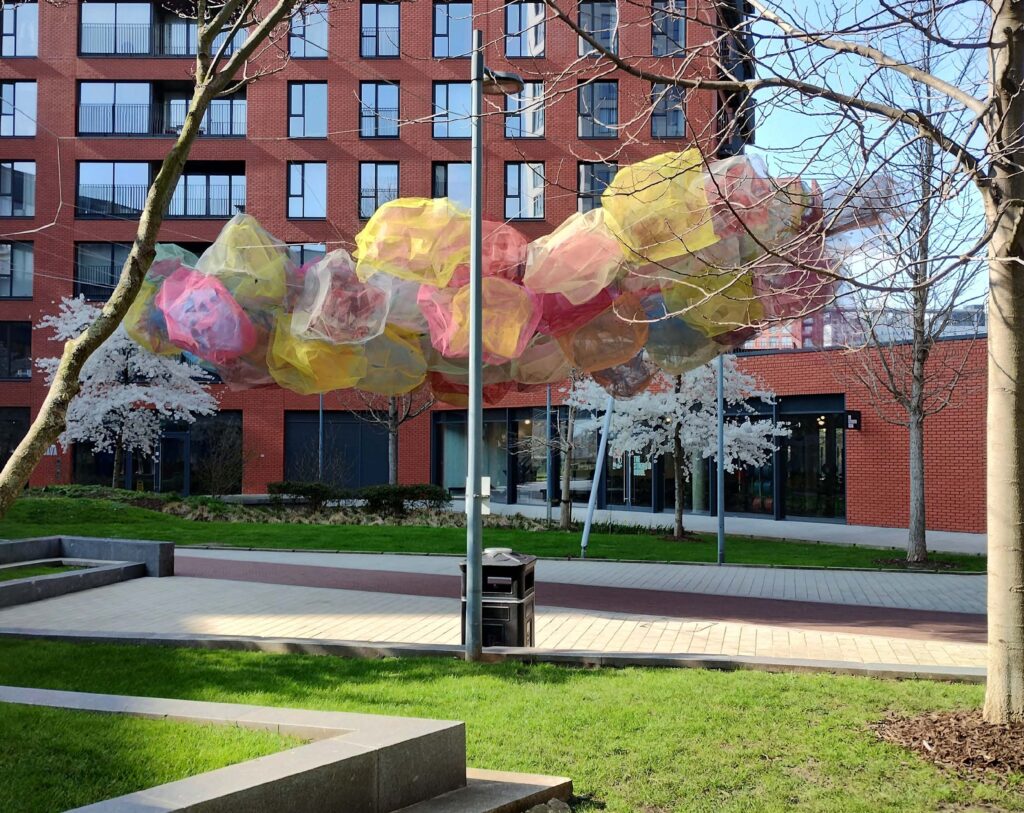
A dramatic work featuring clouds of suspended coloured mesh appearing to float
above the central pathway of London City Island.
Commissioned by Ballymore through their collaboration with the public art trail The
Line, the project involved community engagement, dance workshops with the
English National Ballet, who have a presence in Botanic Square, and a film by the
London Film School.
Installed in 2022, it was always intended to be temporary. No 1104 Catching Colour was created by Rana Begum. She was inspired by the reflection of light on the local environment from the river which winds around the island. Begum has said her interest in geometric shapes, colour and light was a perfect fit for London and her memory of the water and Bengali fishing nets suspended over water of her childhood were a starting point for the work.
Rana Begum was born in 1977 in Bangladesh, coming to England at age 8, she
studied at Chelsea College of Art and the Slade School of Fine Art. She now
lives and works in London.
There are photographs of the sculpture Muamba Grove in the link below.
Physicality and interaction were linked to the Muamba Grove series of sculptures
created by Vanessa Silva in the Churchyard of St Botolph-without-Bishopsgate. The
figures which she identified as neither human nor part of nature but hybrids,
constantly in a state of flux have inspired dance classes around them.
Her use of colour and scale contributed to the sense of dynamic and fluid movement
connected to her native choreography and transformation. Vanessa da Silva was born in Brazil in 1976. She came to live in London in 2000 and studied at the Royal College of Art.
Lastly, a note that there are some works a bit different to the others in this article;
statues of heroes. Interestingly it is a Czech artist – František ‘Franta’ Bēlsky who
was known for his large-scale statues and busts of British 20th century figures
including Winston Churchill and the British Royal Family.
Franta Bēlskÿ was born in Czechoslovakia in 1921 and came to England in
1948 after the communist takeover of his country. There are two of his works in London I wanted to mention, not in parks but in public places; one of Admiral Cunningham in Trafalgar Square and the other of Lord Mountbatten in Horse Guards Parade.
Bēlsky’s Torsion Fountain used to be in the courtyard of the old Shell Centre. Designed for water to cascade gracefully down its polished surface creating a tranquil oasis within the bustling cityscape. An invitation perhaps to touch and experience movement and fluidity. The company moved to another site on the South Bank on land which once hosted the Festival of Britain and the fountain has not yet been reinstalled.
I chose to include him and awareness of his work because of a quirk which amused me. This prolific artist had a trademark trick which was to hide, inside his culptures, a newspaper front page, a coin of the year and a signed note inside a Guinness bottle! I do not know if anyone has found these.
This is a very small taster, identifying some sculptures and art created by immigrants, and where possible the contribution and influence they have had on
London Parks and Gardens and green spaces. I believe there are many more to be
discovered. I hope this article might spark an interest or curiosity which could lead to further explorations and wonderful discoveries.
If you do find anything similar or of interest in this context or that you think
might inspire others, please let us know. You can contact us at
office@londongardenstrust.org
This article would not have taken shape without the support, advice and camera of
Barbara Deason, LPG Trustee. I am extremely grateful to her.